Picture this: your team is busy, patients are coming in, and the schedule looks healthy. But every month, your collections fall short. The culprit? Missed referrals. In Texas and across the US, missed referrals are one of the biggest hidden problems sabotaging your revenue cycle optimization efforts. Most practices don’t realize it’s happening until the losses stack up and your cash flow suffers.
Key takeaway:
- Average practice loses $52,000/year from referral issues, but 68% are preventable
- Missing referrals, expired authorizations, and out-of-network referrals account for 78% of denials
- Referral leakage alone costs $420,000 yearly for practices with 35% leakage rate
- Referral problems delay cash flow 3-4x and consume 40% of billing staff time
- Simple solutions like front-desk checklists and tracking software deliver 450-800% ROI
The Numbers That Should Make You Pause
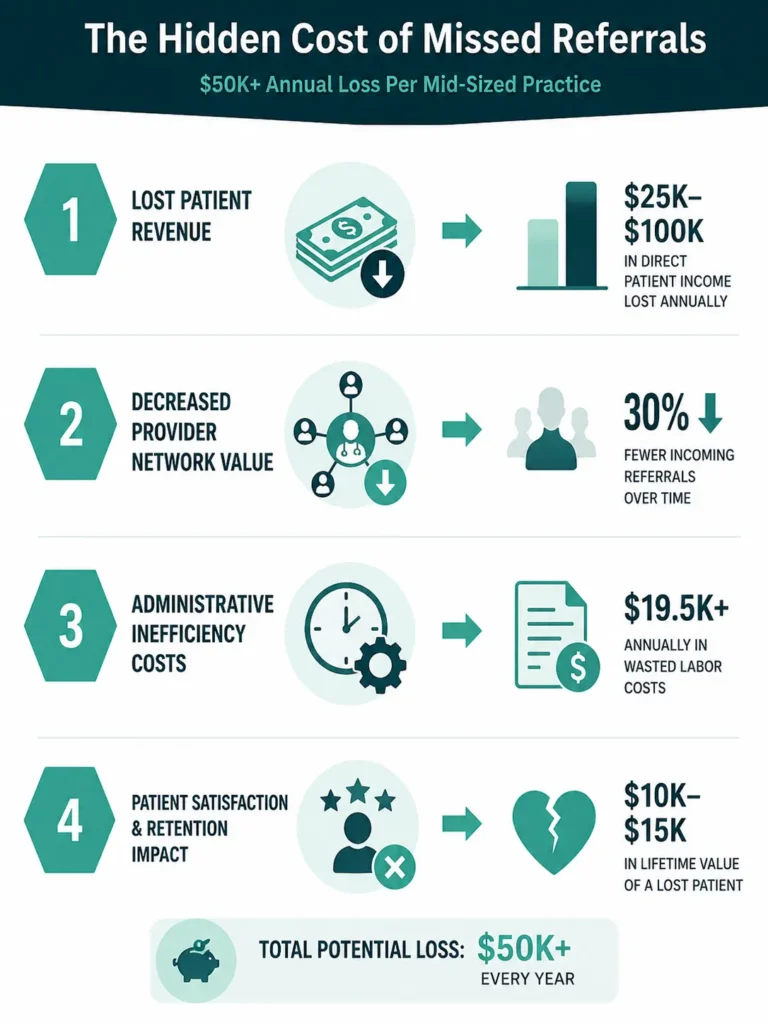
Healthcare revenue cycle losses from referral problems are bigger than most people expect. Nationally, denied insurance claims cost providers $262 billion every year. About 15 to 20 percent of those denials trace back to referral issues. For a practice handling around 300 referrals a month, that single problem can put $780,000 of revenue at risk annually.
The average practice loses $52,000 a year from referral problems alone, according to MGMA 2024 data. And here is the part that stings: 68 percent of those claim denials are completely preventable.
That is not a billing department failure. That is a process gap that compounds every single month.
What Actually Goes Wrong: Where Referrals Break Down
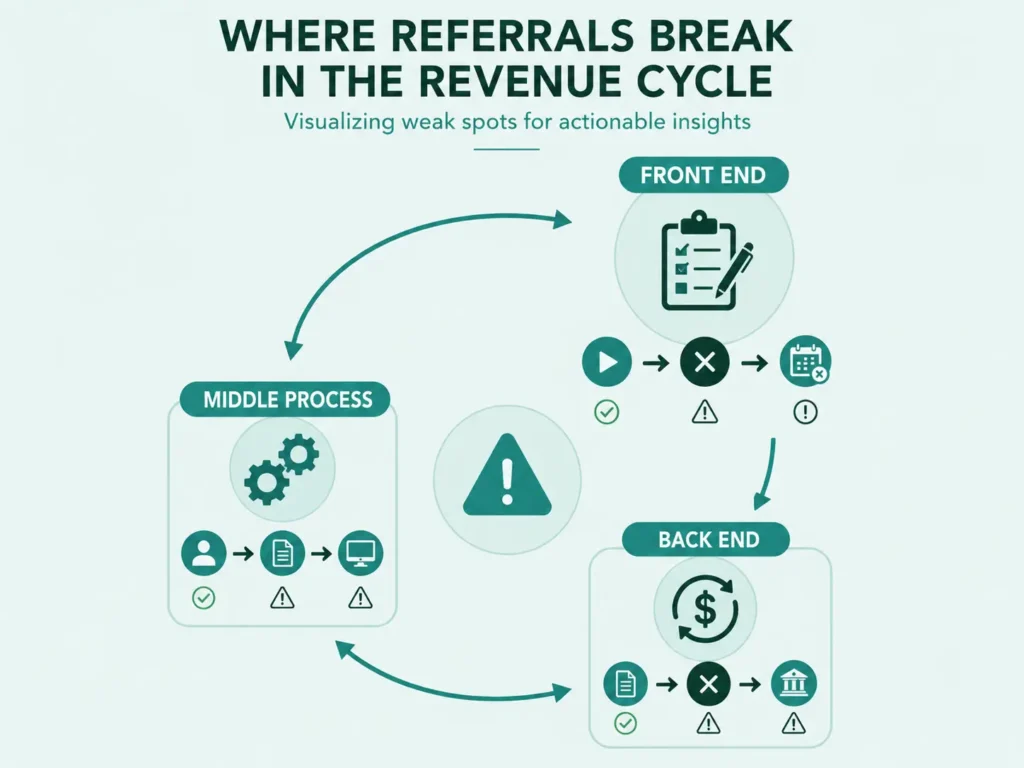
Understanding what is rcm cycle in medical billing helps explain why this matters so much. The referral sits at the very front end of the revenue cycle. If it is wrong or missing, every step after it, coding, claims submission, payment, gets harder.
The Most Common Reasons a Referral Gets Denied
Front desk teams deal with these every day in Texas practices. Here is what shows up most often in denial management healthcare reports:
- Missing referral number (32% of denials)
- Expired referral authorization (28%)
- Patient sent to an out-of-network specialist (18%)
- Incorrect referral information (14%)
- Missing diagnostic codes (8%)
HMO plans require referrals for more than 90 percent of specialist visits. Medicaid has strict rules too. And Medicare Advantage, which jumped from 45 to 54 percent enrollment between 2023 and 2024, is pushing more referral requirements every year.
Referral Leakage: The Revenue You Never See Leave
Referral leakage is when a patient gets sent to an out-of-network provider and that visit revenue never touches your system. Practices without a tracking setup lose 30 to 40 percent of referrals this way. Each leaked referral costs about $3,500 in downstream revenue.
A practice with 100 monthly referrals and a 35 percent leakage rate loses around $420,000 a year. Not from denied claims. Just from patients walking out the door to the wrong provider.
Why does it happen? Outdated specialist directories. Patients asking for a specific doctor. No real-time network status check. Poor provider relationship management between the primary care office and the specialist. These are not dramatic failures. They are quiet, daily gaps that add up.
What This Does to Your Cash Flow
A normal claim gets paid in 14 to 21 days. A claim with a referral problem? You are looking at 45 to 90 days after the denial, the investigation, the resubmission, and the final adjudication. That is three to four times longer.
A family practice in Texas with $2.4 million in annual revenue found $180,000 sitting in referral-related denied claims at any given moment. That is 7.5 percent of their entire annual revenue stuck in limbo, not written off, just waiting while their team scrambled.
The impact of denials on the revenue cycle includes more than delayed cash. It means staff overtime, collections costs rising 200 to 300 percent, and billing teams spending 40 percent of their time chasing referral issues instead of moving clean claims forward.
The Patient Side of the Story
Referral problems do not just affect your revenue. They affect the person sitting in the waiting room. Forty-five percent of patients say they feel confused about where their referral stands. Thirty-eight percent experience delays in getting their specialist appointment. And 31 percent say they think about switching providers after a referral goes sideways.
When a patient shows up to a specialist and finds out the referral was never sent, they do not blame the insurance company. They blame your practice. That is a review left online, a patient who does not come back, and a story told to every friend and family member who asks.
How Texas Practices Are Fixing This
The good news is that the solutions are not complicated. What they require is consistency. Here is what practices across Dallas, Houston, and Fort Worth have done to turn this around.
Fix the Front End First
The patient intake process is where most referral problems start. When the front desk verifies insurance plan requirements at scheduling, confirms the specialist is in-network, and checks that authorization is current at check-in, denial rates drop fast. One 12-provider group in Texas cut referral-related denials by 67 percent in six months just by adding a front-desk checklist.
Staff need real training, not just a one-page handout. Eight to twelve hours of initial training on insurance requirements, monthly refreshers on the top denial reasons, and payer-specific guidance for the major plans in your area make a real difference. Learn more about strengthening your
patient intake process to prevent issues before they start.
Use Referral Tracking Software
Referral tracking software that connects to your EHR changes everything. The system flags missing referrals at scheduling, sends expiration warnings 15 days out, and alerts staff when a patient is being sent to an out-of-network provider. According to
MGMA’s Revenue Cycle Benchmark data, practices using integrated referral management solutions see denial rates drop 20 to 30 percent in the first year.
The cost runs from $300 to $800 a month. The savings run $35,000 to $120,000 annually. Most practices break even in three to six months.
Close the Loop with Your Specialists
Forty-seven percent of specialists do not send consultation notes back on time. That breaks the referral process in ways that affect both patient safety and billing accuracy. Closed-loop referral communication means setting up a 48-hour rule for consultation notes, sending automated alerts to the PCP when the note arrives, and tracking completion rates by specialty. Practices with this system report 32 percent better patient outcomes and 28 percent higher patient satisfaction. Check our referral management best practices guide for a step-by-step setup.
Build a Denial Management Workflow That Actually Works
Treating each denial as a one-off problem is how practices write off money they could recover. The impact of denials on the revenue cycle includes patterns that repeat every month. Track denial trends by payer, by denial reason, and by specialty. Hold a monthly review. When you see the same issue appearing for the same insurance plan three months in a row, that is a process problem, not bad luck.
Practices with a structured denial management healthcare approach recover $15,000 to $45,000 a year in previously written-off revenue. That money was always there. It just needed someone to go after it.
What Real Practices Saw After Fixing Their Referral Process
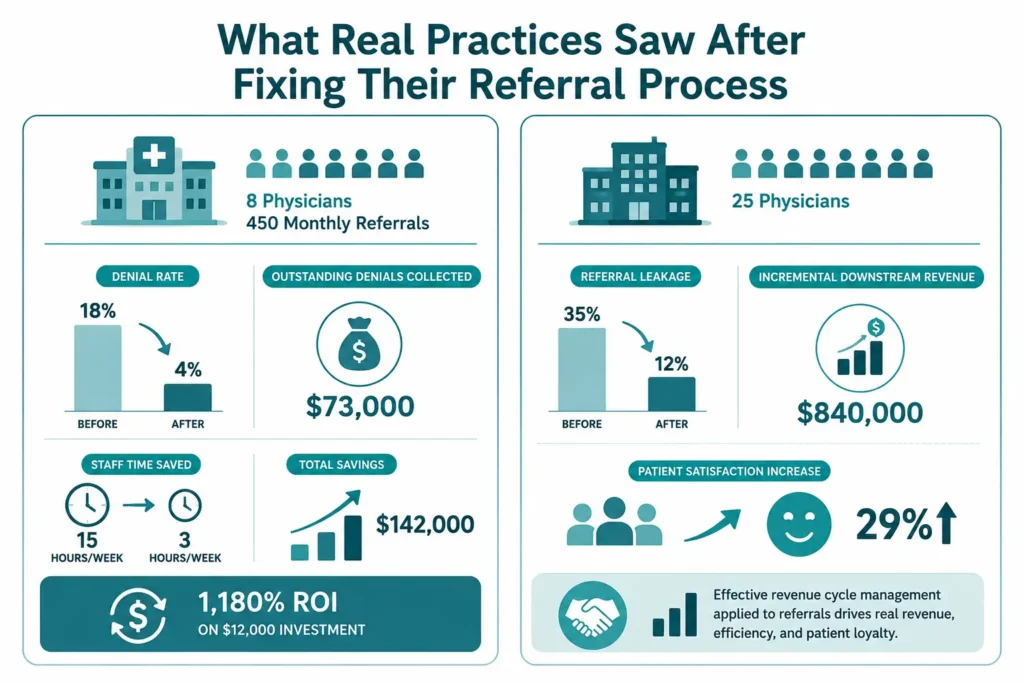
A primary care practice in Dallas with eight physicians and 450 monthly referrals had an 18 percent denial rate on referral-related claims. After implementing referral tracking software with EHR integration and a front-desk verification protocol, their denial rate fell to 4 percent. They were able to collect $73,000 on outstanding denials and reduce their staff referral management time from 15 to 3 hours per week. These efforts saved them $142,000, delivering a 1,180 percent ROI on their $12,000 software investment.
A multi-specialty practice with 25 physicians in Houston had 35 percent referral leakage. Within one year of implementing a referral management system internally along with closed-loop referral management practices, they reduced leakage to 12 percent. They realized $840,000 in incremental downstream revenue along with a 29 percent increase in patient satisfaction.
These are not outliers. They are what happens when effective hospital revenue cycle management and revenue cycle optimization get applied to the referral process specifically.
The referral process is the step where a primary care provider sends a patient to a specialist. In revenue cycle management rcm, it sits at the front end and must include correct authorization, insurance verification, and documentation to avoid claim denials.
A practice with 100 monthly referrals and 35 percent referral leakage loses roughly $420,000 a year in downstream healthcare revenue. Most practices have no system tracking this loss, so it goes unnoticed for years.
Denial management healthcare is the process of identifying, appealing, and preventing denied insurance claims. For referral-related denials specifically, structured denial management can recover $15,000 to $45,000 annually that practices currently write off.
The referral tracking system helps set reminders for expiration dates, identify unapproved authorizations, and verify the network status prior to the scheduled appointment. It prevents claim rejections, accelerates payment collection, and helps optimize the entire revenue cycle.
Check out your denial reports over the past three months to determine how many referrals are and what the total dollar amount is. Then implement a front-desk verification checklist. Most practices see an immediate drop in denied insurance claims within 30 to 60 days of adding this one step.
Ready to Stop the Bleeding? Start This Week.
Pull your denial reports from the last 90 days and find out how many referrals are related. Put a dollar amount on it. Survey your staff about where the breakdown happens. You will know within days whether this is a $20,000 problem or a $200,000 one.
A front-desk verification checklist costs nothing and works immediately. Staff training on your top five payers takes one afternoon.
Revenue does not disappear all at once. It drips out one missed referral at a time. Practices that catch it grow early. The ones that ignore it keep wondering why the numbers never add up.
If you want to help tighten your referral and billing process, Integrate Point works with medical practices to fix exactly these gaps.