You’re running 15 minutes behind schedule. Again. The waiting room is full. Your nurse just handed you another chart. Meanwhile, you’re still typing notes from the patient you saw 20 minutes ago. Your back hurts from hunching over the computer. You’re exhausted, and it’s only 2 PM.
This is what thousands of physicians in Dallas and across Texas experience every single day. The irony? You went to medical school to see patients, not to fight with computers. Yet here you are, spending more time typing than talking to the people you’re actually trying to help.
What if I told you there’s a solution that actually works? Medical scribes. Not the idea of them. Not fantasy. The real thing that practices across Dallas and Texas are using right now is to reclaim their sanity, their schedules, and their love for medicine.
Let me show you exactly how.
Key Takeaway:
- Medical scribes reduce physician documentation time by 40-50%, freeing time for patient care
- Physician burnout drops measurably when administrative burden is removed
- Remote medical scribes offer flexibility and cost savings over in-house employees
- Patient flow optimization happens naturally when physicians aren’t typing
- EMR integration with modern scribes is seamless and error-reducing
- ROI typically breaks even in the first month through increased patient volume
What Medical Scribes Actually Do
A medical scribe isn’t a glorified data entry person. A certified medical scribe is a trained healthcare professional who documents patient encounters in real time while you focus on what matters: the patient in front of you.
Here’s how it works. You walk into the exam room. Your scribe is already there or joining via telehealth. You talk to your patient. Your scribe listens, takes notes, and documents everything in your EMR system in real time. By the time you leave the room, the note is essentially complete. No backlog or staying late to chart. No typing after hours.
For physicians in Dallas and Texas managing high patient volumes, this changes everything.
Your scribe captures the clinical details. They document vital signs, patient history, examination findings, and assessment. They ensure nothing falls through the cracks. Your clinical documentation improves because someone trained in healthcare documentation is doing it, not you rushing between patients.
How Medical Scribes Help Physicians: The Real Benefits
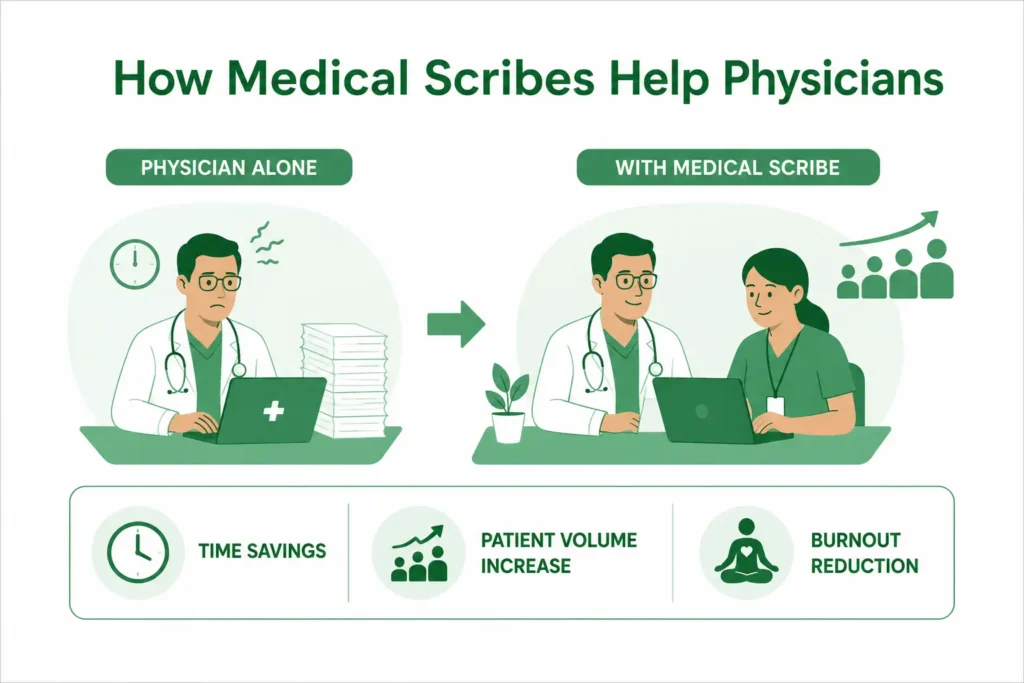
You See More Patients Without Burning Out
Here’s the math that matters. Physicians spend 40% to 50% of their day on documentation. That’s not exaggeration. That’s documented fact from healthcare studies. A medical scribe eliminates that burden almost entirely.
One Dallas cardiology group added a single scribe to their practice. They went from seeing 18 patients daily to 22 patients daily without increasing stress. The scribe handled all documentation. The physician just practiced medicine.
For your practice, that could mean an extra $50,000 to $100,000 in annual revenue without seeing a single additional patient. You’re just using your time differently.
Physician Burnout Drops Significantly
Burnout doesn’t come from seeing patients. It comes from the administrative burden that sits between you and patient care. When a medical scribe removes that burden, something shifts.
Physicians report they actually enjoy work again. They see their patients, make clinical decisions, and head home by 5 PM. They’re not worn out at the end of the day or stuck in the office until 7 PM finishing charts.
Practices across Texas that implemented scribes reported 34% improvement in physician satisfaction scores within three months.
Patient Relationships Actually Improve
This surprises people, but it’s true. When you’re not typing, you make eye contact. You listen better. You ask follow-up questions. Patients feel seen.
Patient relationship management improves dramatically because you have mental bandwidth for actual conversations instead of fighting your computer during the visit.
EMR and EHR Integration Becomes Seamless
Your scribe works directly in your EMR system. Whether you use Epic, Cerner, Athenahealth, or any other platform, the integration is clean. Your scribe documents once, and everything automatically syncs. No duplicate entry or rework. No errors from manual data transfer.
Clinical documentation improvement happens naturally because your notes are complete, accurate, and timely.
The Choices: In-House vs. Remote Medical Scribes
In-House Scribes
Some practices hire scribes directly. Your scribe sits in your clinic every day. You see them every morning. They know your workflow, your preferences, and your patients.
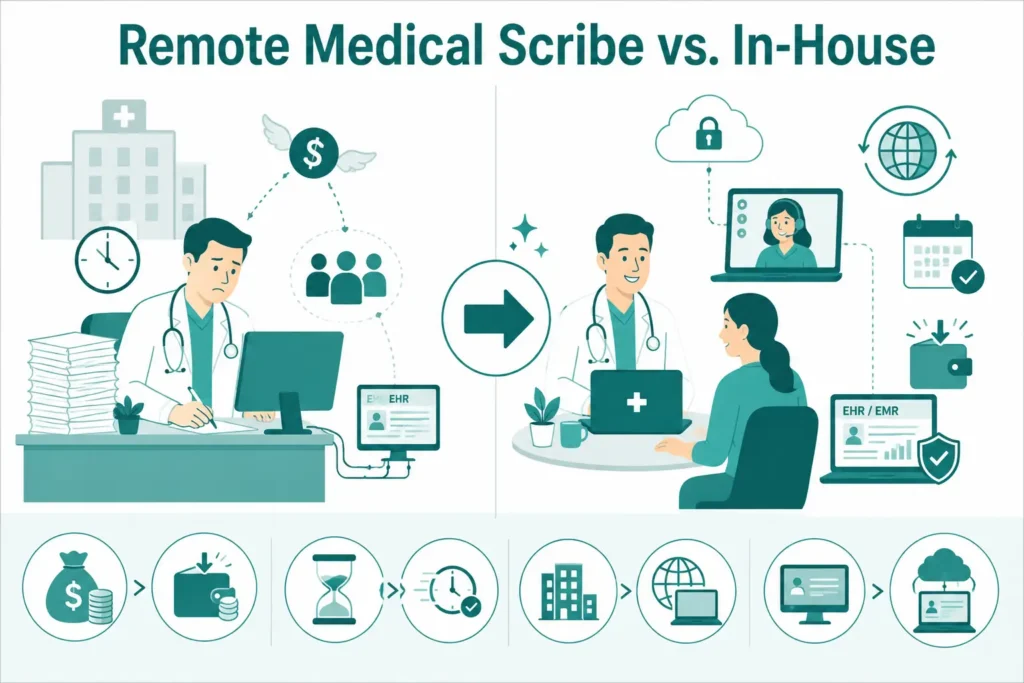
The downside? You’re paying salary, benefits, payroll taxes, and training. A full-time employee costs $35,000 to $50,000 annually plus overhead. For solo practice or small group, that’s significant.
Remote Medical Scribes
Here’s where it gets interesting. Remote medical scribes work from anywhere, usually joining your patient encounters via video. They see your patient on screen, hear the conversation, and document in real time. You get all the benefits of a scribe without the employee overhead.
Practices across Dallas increasingly choose remote scribes because they’re more flexible, more affordable, and just as effective. Your scribe can cover your clinic from 8 AM to 6 PM without being physically present.
Comparing Best Medical Scribe Companies in Texas
If you’re looking at top medical scribe companies, you’re evaluating several factors. You can choose from companies that provide only in-house scribes, only remote scribes, or a combination of both.
The best medical scribe companies in your area (Dallas, Houston, San Antonio, Austin) understand Texas healthcare. They understand HIPAA requirements, train their scribes on Texas regulations, and stay up to date with state healthcare compliance.
When evaluating companies, ask these questions:
- How long does scribe training take?
- What happens if your scribe gets sick?
- How do they handle peak volume periods?
- What’s your actual cost per hour?
- Do they integrate with your EHR?
- What’s their quality assurance process?
Don’t just pick the cheapest option. Pick the one that understands your practice.
Why Practice Management Systems Matter
Your practice management system connects to everything. Your EMR, your billing, your scheduling, your revenue cycle. A scribe should integrate seamlessly with your practice management system, not work around it.
The best implementations happen when your scribe, your EHR, and your practice management system all talk to each other. Workflow automation healthcare becomes possible when everything is connected.
Dallas and Texas Healthcare Context
Texas healthcare is unique. You’ve got urban practices in Dallas with 50+ physicians and rural practices with two doctors, got insurance mix that varies significantly. You’ve got patient populations with different needs.
A scribe solution that works for Dallas might not work for rural East Texas. The best certified medical scribe companies understand these differences. They adjust their approach based on your location and patient mix.
Practices across Dallas report that adding a scribe changed their ability to serve more patients without losing quality. Healthcare technology trends show that scribes are one of the most effective practice efficiency tools available right now.
The Money Question: Medical Scribe Salary and ROI
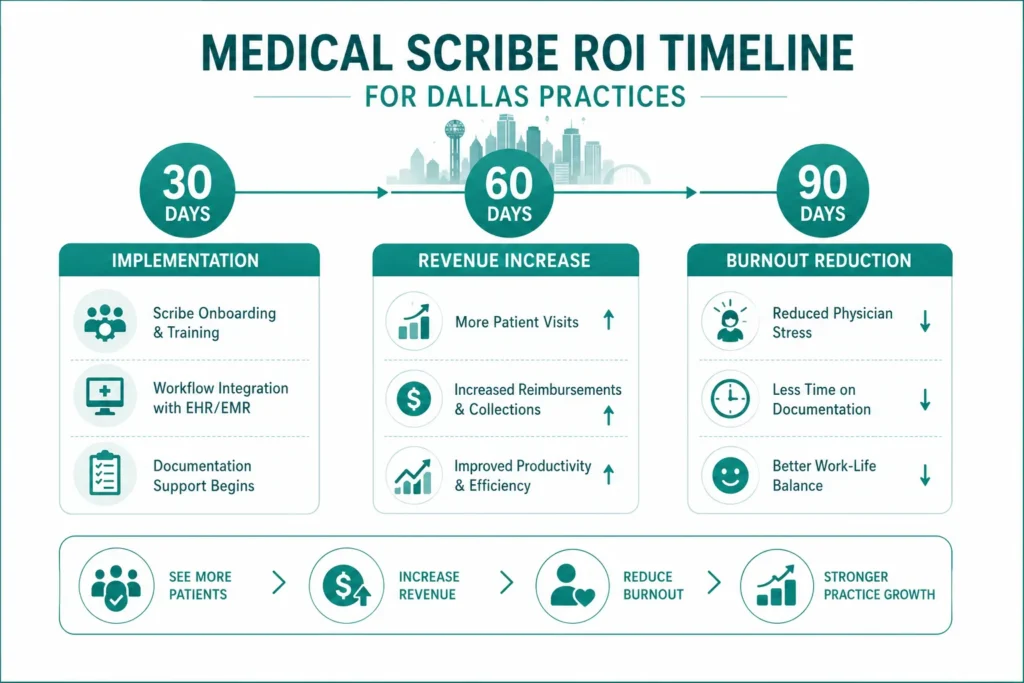
Let’s be direct about cost. A certified medical scribe costs between $15 and $25 per hour depending on experience and location. For 40 hours weekly, that’s $600 to $1,000 per week, or roughly $2,400 to $4,000 monthly.
In return, you typically see:
- 4-6 additional patient visits weekly (conservative estimate)
- $80 to $150 revenue per additional visit
- $320 to $900 additional weekly revenue
- $1,280 to $3,600 additional monthly revenue
Your net benefit? $1,000 to $2,600 monthly in additional revenue, minus the scribe cost. Break-even happens in the first month for most practices.
That’s before calculating the value of your time back, reduced burnout, or improved patient satisfaction.
Getting Started: A 30-Day Action Plan
Week 1: Assess Your Current Documentation Burden
Track how much time you spend on EMR documentation daily. Most physicians are shocked by the actual number. It’s usually 2-4 hours every 8 hours of clinical time.
Week 2: Identify Your Needs
Do you want in-house or remote? Full-time or part-time? What specific areas drain your time most (note writing, order entry, prior authorization documentation)?
Week 3: Research Local Options
Talk to other practices in Dallas using scribes. Ask about their experience. Get real feedback from real physicians. Contact 2-3 certified medical scribe companies for proposals.
Week 4: Implement Your Pilot
Start with one provider using one scribe for two weeks. Track the results. Measure time savings, patient volume changes, and physician satisfaction.
Most practices that pilot scribes decide to keep them within 30 days because the results are undeniable.
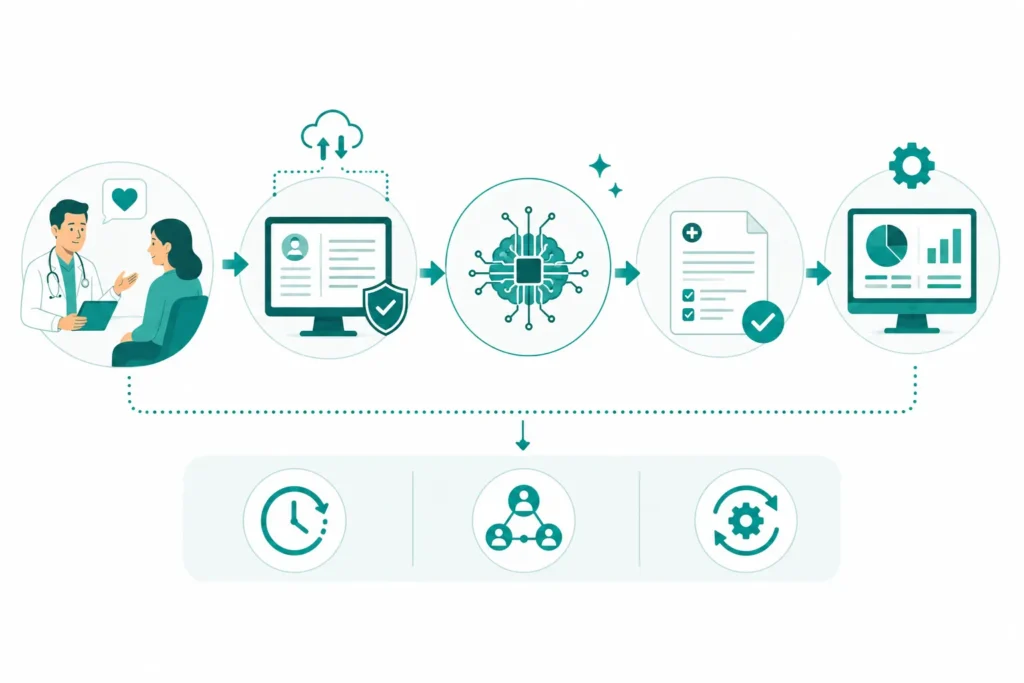
Medical scribes reduce documentation burden by 40-50%, increase patient flow optimization, improve clinical documentation improvement, and decrease physician burnout. They enhance patient relationship management and EHR/EMR efficiency.
By handling EMR documentation in real time, scribes free physicians to see additional patients. This improves patient flow optimization and clinical staffing solutions, increasing practice revenue without added stress.
Remote medical scribes work via telehealth, offering flexibility and lower medical scribe salary costs. In-house scribes provide daily presence. Both integrate with practice management systems and offer clinical documentation improvement.
Medical scribe salary typically ranges $15-$25/hour. Most practices break even within one month through increased patient volume and improved workflow automation healthcare.
Yes. By enabling healthcare automation and workflow optimization, scribes improve clinical documentation improvement, patient relationship management, and care quality through better physician focus on patients.
Ready to Reclaim Your Time?
You didn’t go to medical school to be a data entry clerk. You went to help people. Medical scribes give you back to medicine.
At Integrate Point, we connect Dallas and Texas physicians with certified medical scribe solutions that work. We handle the integration with your EMR, manage the scribe relationship, and ensure your clinical documentation improves. Most practices see benefits within their first month.
Stop fighting with your computer. Start seeing patients again.
Schedule a consultation with Integrate Point today and find out how a medical scribe can transform your practice. We’ll analyze your current workflow, calculate your actual ROI, and show you exactly what’s possible for your practice.