The $31 Billion Administrative Burden Nobody Talks About
Every week, your clinical staff spend countless hours on the phone with insurance companies, chasing prior authorizations that should take minutes, not days. While your patients wait for life-saving treatments, your revenue sits frozen in bureaucratic limbo.
- The brutal reality for healthcare providers
- The Prior Authorization Crisis: For Practices
- The Prior Authorization Crisis: Impact on Patients
- Understanding the Prior Authorization Process in US Healthcare
- Services Commonly Requiring Prior Authorization
- The Current Process and Why It's Broken
- Change in Prior Auth: CMS Final Rule (January 2024) New Federal Requirements
- What This Means for Wylie and DFW Healthcare Providers
- State-Level Changes: Texas Prior Authorization Laws
- Electronic Prior Authorization Automation for Healthcare Efficiency
- Benefits of Electronic Prior Authorization Automation
- Essential Features in Prior Authorization Software
- Addressing Specific Provider Challenges
- Medicare and Medicaid Prior Authorization Changes
- Medicaid Prior Authorization Reforms
- Best Practices for Prior Authorization Management
- Regional Advantages: Navigating Prior Auth in the DFW Metroplex
- Helping Patients Navigate Prior Authorization
- Case Studies: Real-World Prior Auth Transformation
- Your Action Plan: Transform Your Prior Authorization Process
- Get Expert Help from Integrate Point
The brutal reality for healthcare providers
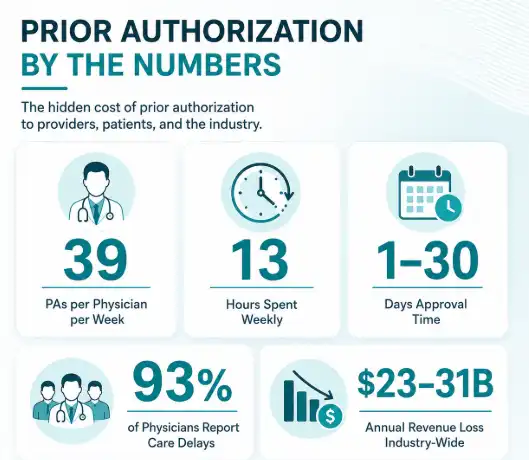
- $31 billion spent annually on prior authorization administration in the US (AMA, 2024)
- 14.9 hours per week average physician time spent on prior auth (per physician)
- 40.1 hours per week for staff per physician on prior authorization tasks
- 35% of providers report prior auth led to serious adverse events
- 93% report prior auth delays necessary care
- 82% abandon treatment due to prior auth burden
For a typical 5-physician practice
- 200+ hours monthly consumed by prior authorization
- $120,000-$180,000 annually in administrative costs
- $85,000+ in delayed revenue at any given time
- 28% of prior auths take longer than 5 business days
For patients: Every delay means worsening conditions, emergency room visits, and potentially irreversible health consequences.
The Prior Authorization Crisis: For Practices
Administrative Burden
- 93% of physicians report prior authorization delays to necessary care
- 82% report prior auth barriers cause patients to abandon treatment
- 91% report the burden has increased over the past 5 years
- 35% report prior auth led to serious adverse events for patients
- 24% report hospitalizations due to prior auth delays
Time Consumption
- Average practice completes 45 prior authorizations per physician weekly
- 2 business days average wait time for decisions
- 19% take more than 5 business days to receive decision
- 16% require peer-to-peer physician review
- 59% require phone calls to insurers for status updates
Financial Impact
- $13,018 annual cost per physician for prior auth administration
- $827,309 annual cost for practices with 5 physicians
- Lost revenue from delayed treatments averaging $85,000 per practice
- Denied authorization appeals costing $150-$300 each
The Prior Authorization Crisis: Impact on Patients
Treatment Delays
- 93% of patients experience care delays due to prior authorization
- Average delay: 7-14 days for routine procedures
- Critical delays: 3-7 days even for urgent/emergent care
- 68% of patients don’t understand the prior auth process
Treatment Abandonment
- 82% of patients abandon or significantly delay treatment
- Main reasons: Cost concerns (45%), frustration with delays (38%), complexity (17%)
- Chronic conditions most affected: Cancer, cardiovascular disease, autoimmune disorders
Health Consequences
- 35% lead to serious adverse events including hospitalization
- ER visits increase 23% when prior auth delays necessary care
- Disease progression accelerates in 42% of delayed cases
- Patient satisfaction drops 47% when prior auth issues occur
Understanding the Prior Authorization Process in US Healthcare
What is Prior Authorization?
Prior authorization (prior auth or PA) is a requirement by health insurance companies that healthcare providers obtain approval before delivering specific services, procedures, or medications.
Purpose (Intended)
- Ensure medical necessity
- Control healthcare costs
- Prevent inappropriate utilization
- Promote evidence-based care
Reality
- Creates massive administrative burden
- Delays necessary care
- Increases provider burnout
- Drives up healthcare costs through inefficiency
Services Commonly Requiring Prior Authorization
High-Cost Procedures
- MRI, CT, PET scans (75% require prior auth)
- Surgical procedures (68%)
- Inpatient hospital stays (82%)
- Specialty consultations (45%)
Medications
- Specialty pharmaceuticals (95% require prior auth)
- Brand-name medications with generic alternatives (78%)
- Controlled substances (84%)
- Biologic medications (92%)
Therapies
- Physical therapy beyond initial visits (65%)
- Mental health services (52%)
- Home health care (71%)
- Durable medical equipment (88%)
The Current Process and Why It’s Broken
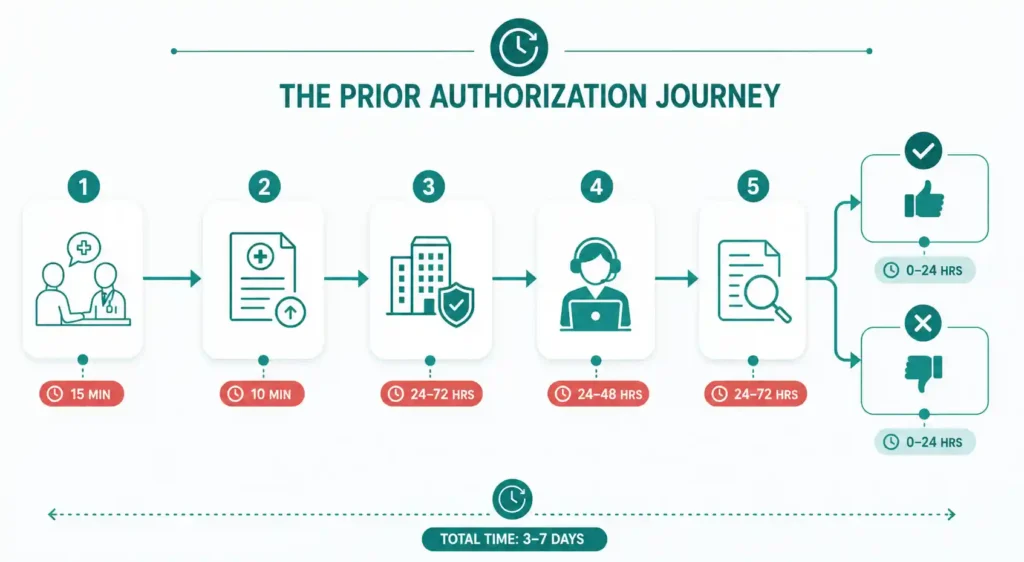
Traditional Prior Authorization Workflow
1: Identify Requirement (30 minutes)
- Check if service requires prior auth
- Verify patient’s insurance coverage
- Confirm which payer system to use
- Problem: Different requirements for every payer, constantly changing
2: Gather Documentation (45-60 minutes)
- Pull patient medical records
- Collect diagnostic test results
- Document medical necessity rationale
- Obtain clinical notes and histories
- Problem: Manual record review, scattered information sources
3: Submit Request (30-45 minutes)
- Complete payer-specific forms
- Upload supporting documentation
- Submit via portal, fax, or phone
- Generate confirmation/tracking number
- Problem: Multiple submission systems, frequent technical failures
4: Wait for Decision (2-14+ days)
- Monitor submission status
- Respond to information requests
- Follow up on pending decisions
- Problem: No transparency, inconsistent timelines, frequent “black holes”
5: Handle Denials/Appeals (2-4 hours each)
- Review denial reason
- Gather additional documentation
- Complete appeal paperwork
- Arrange peer-to-peer review if needed
- Resubmit and wait again
- Problem: High denial rates (20-30%), complex appeal processes
6: Communicate with Patient (15-30 minutes)
- Notify patient of approval or denial
- Explain delays or next steps
- Coordinate scheduling
- Problem: Frustrated patients, multiple touchpoints required
Total Time Investment: 3-8 hours per prior authorization for complex cases
Change in Prior Auth: CMS Final Rule (January 2024) New Federal Requirements
The Centers for Medicare & Medicaid Services (CMS) issued final rules requiring:
1. Electronic Prior Authorization (ePA) APIs
- Effective Date: January 1, 2026
- Requirement: Payers must implement FHIR-based APIs
- Impact: Real-time prior auth submission and decision-making
- Who it affects: Medicare Advantage, Medicaid, CHIP, Qualified Health Plans
2. Faster Decision Timelines
- Urgent requests: 72 hours (down from 14 days)
- Standard requests: 7 calendar days (down from 14 days)
- Expedited appeals: 72 hours
- Standard appeals: 30 calendar days
3. Transparency Requirements
- Public posting of prior auth requirements and criteria
- Reason for denial must be specific and detailed
- Historical data reporting on approval/denial rates
4. Automation and Standardization
- Standardized attachments replacing proprietary forms
- Reduce burden on routine, low-risk services
- Streamline renewals for ongoing treatments
What This Means for Wylie and DFW Healthcare Providers
Immediate Requirements (2024-2025)
- Review current prior auth volumes and processes
- Assess EHR readiness for API integration
- Train staff on new timelines and requirements
- Update workflows for faster turnaround expectations
By January 2026
- Implement or upgrade to FHIR-compliant EHR systems
- Integrate with payer ePA APIs
- Develop protocols for 72-hour urgent decisions
- Create transparency dashboards for patients
Benefits Once Implemented
- 60-80% reduction in manual submission time
- Real-time decisions for routine procedures
- Fewer denials due to standardized criteria
- Better patient experience with clear timelines
State-Level Changes: Texas Prior Authorization Laws
Texas House Bill 3459 (Effective 2023)
Key Provisions:
- Continuity of care protections when changing insurers
- Prior auth exemptions for certain preventive services
- Transparency requirements for denial reasons
- Appeal timelines must be clearly communicated
Impact on Texas Clinics
- Reduced prior auth burden for preventive care
- Better protection for patients with chronic conditions
- Clearer processes for challenging denials
Electronic Prior Authorization Automation for Healthcare Efficiency
What is Electronic Prior Authorization (ePA)?
Electronic prior authorization automates the traditional manual process through:
Key Components:
- EHR integration: Prior auth requests initiated directly from clinical workflow
- Real-time eligibility: Instant verification of coverage and requirements
- Clinical decision support: Automated checks for medical necessity criteria
- API connectivity: Direct system-to-system communication with payers
- Status tracking: Real-time visibility into approval process
Benefits of Electronic Prior Authorization Automation
Time Savings
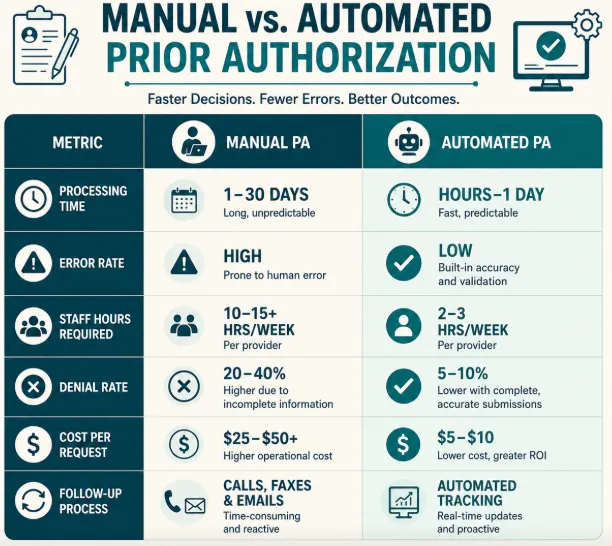
- 75-85% reduction in manual data entry
- Automated form completion from EHR data
- Real-time status updates eliminating phone calls
- Average processing time: 5-15 minutes vs. 2-4 hours
Improved Accuracy
- 40-60% fewer errors from automated data transfer
- Built-in compliance checks against payer requirements
- Reduced denials through upfront validation
- Automatic alerts for missing information
Financial Benefits
- $8-12 savings per prior authorization in labor costs
- Faster approvals reducing days in A/R
- Higher approval rates (85-90% vs. 70-75% manual)
- ROI typically achieved within 6-12 months
Better Patient Experience
- Real-time status visibility through patient portals
- Faster treatment initiation due to quicker approvals
- Proactive notifications of approval decisions
- Reduced patient inquiries about status

Essential Features in Prior Authorization Software
When evaluating ePA solutions, look for
EHR Integration
- Bi-directional data flow with your EHR
- Single sign-on access
- Embedded within clinical workflow
- Supports your specific EHR (Epic, Cerner, Athena, eClinicalWorks, etc.)
Payer Connectivity
- Direct API connections to major payers
- Coverage for Medicare Advantage, Medicaid, commercial insurers
- Real-time eligibility verification
- Automatic payer requirement updates
Clinical Decision Support
- Evidence-based medical necessity criteria
- Specialty-specific protocols
- Drug formulary integration
- Alternative treatment suggestions
Workflow Automation
- Automated form population from EHR
- Intelligent routing to appropriate payers
- Status tracking and alerts
- Appeals management workflows
Analytics and Reporting
- Approval/denial rates by payer and procedure
- Time-to-approval metrics
- Staff productivity tracking
- Financial impact analysis
Patient Engagement
- Patient portal integration
- Automated status notifications (text, email, portal)
- Educational resources about the process
- Transparency into approval criteria
Addressing Specific Provider Challenges
1: Physician Burnout from Prior Auth Burden
The Problem:
- 58% of physicians report prior auth contributes significantly to burnout
- Administrative time exceeds clinical time in many specialties
- 24% consider leaving medicine partly due to administrative burden
- Moral distress from inability to provide timely care
Solutions:
- Delegate Effectively:
- Hire dedicated prior authorization specialists
- Use medical assistants or care coordinators for routine cases
- Outsource to specialized prior auth services for complex cases
- Implement Technology:
- Electronic prior authorization systems integrated with EHR
- Clinical decision support to identify requirements early
- Automated status tracking eliminating phone calls
- Streamline Workflows:
- Batch processing of routine prior auths
- Standard protocols for common procedures
- Pre-visit identification of prior auth needs
- Advocate for Change:
- Join physician organizations lobbying for reform (AMA, state medical societies)
- Document adverse patient outcomes from delays
- Participate in payer quality improvement initiatives
2: High Denial Rates and Appeals
The Problem:
- 20-30% denial rate for initial prior authorization requests
- Each appeal costs $150-300 in administrative time
- 70% of appeals are successful, indicating arbitrary initial denials
- Patients abandon treatment when faced with denials
Solutions:
- Improve Initial Submissions:
- Use templates with proven success rates for your specialty
- Include comprehensive clinical documentation upfront
- Reference evidence-based guidelines in submission
- Ensure all payer-required fields are complete
- Implement Denial Management System:
- Track denial reasons by payer and procedure type
- Identify patterns requiring workflow changes
- Create specialty-specific appeal letter templates
- Assign dedicated staff for appeals management
- Leverage Technology:
- Prior auth software with built-in compliance checks
- Real-time feedback on submission completeness
- Automated appeals tracking and deadline management
- Analytics to identify problematic payers or procedures
- Build Payer Relationships:
- Request quarterly meetings with medical directors
- Understand specific payer criteria and preferences
- Establish peer-to-peer protocols for complex cases
- Participate in payer provider advisory councils
3: Specialty-Specific Prior Auth Issues
- Oncology:
- Challenge: Time-sensitive treatments, complex drug regimens, frequent protocol changes
- Solution: Specialized oncology prior auth services, clinical trial enrollment documentation, patient financial counselors
- Cardiology:
- Challenge: Urgent procedures, high-cost diagnostics, device implants requiring auth
- Solution: Evidence-based submission packages, relationships with cardiology medical directors, expedited review processes
- Orthopedics:
- Challenge: High volume of imaging prior auths, surgical procedures, DME authorizations
- Solution: Batch processing systems, imaging-specific software, preferred surgical protocols
- Mental Health/Behavioral Health:
- Challenge: Limited network providers, step therapy requirements, frequent authorization renewals
- Solution: Integrated behavioral health platforms, measurement-based care documentation, telethel integration
- Specialty Pharmacy:
- Challenge: High-cost medications, complex specialty pharmacy networks, extensive documentation requirements
- Solution: Pharmacy benefit manager integration, patient assistance program coordination, specialty pharmacy partnerships
Medicare and Medicaid Prior Authorization Changes
Current Challenges
- Medicare Advantage (MA) plans have significantly more prior auth requirements than traditional Medicare
- 73% of MA enrollees in plans with prior auth requirements for certain services
- Inconsistent requirements across different MA plans
- Delays in skilled nursing, home health, and inpatient rehab
2024-2026 Improvements
Reduced Prior Auth Requirements:
- CMS removing prior auth for certain low-denial services (approved <1% denial rate)
- Expedited reviews for previously approved services
- Eliminating redundant reviews for ongoing treatments
Improved Transparency:
- MA plans must publicly post prior auth requirements
- Real-time status tracking for providers and beneficiaries
- Denial reason specificity requirements
Faster Decisions:
- 14-day to 7-day reduction for standard decisions
- 72-hour requirement for urgent needs
- Automatic approval if timelines not met
Provider Benefits:
- Fewer unnecessary prior auths for stable patients
- Predictable timelines for scheduling procedures
- Better transparency reducing “surprise” denials
Medicaid Prior Authorization Reforms
State-by-State Variations
Medicaid is state-administered, so prior auth requirements vary significantly. Texas Medicaid has made several improvements:
Texas Medicaid Changes (2023-2024)
Expanded Exemptions:
- Preventive care services no longer require prior auth
- Routine mental health visits streamlined
- Chronic disease management medications exempt for established patients
- Emergency services auto-approved
Simplified Processes:
- Online portal for all prior auth submissions
- 24-48 hour standard decision timeline
- Automatic approvals for previously authorized ongoing treatments
- Reduced documentation requirements for routine services
Enhanced Coverage:
- Extended postpartum coverage to 12 months
- Expanded behavioral health services without prior auth
- Telehealth parity with in-person services
Impact on Wylie/DFW Medicaid Providers:
- 60% reduction in prior auth volume for pediatric practices
- Faster access to mental health services
- Improved medication adherence for chronic conditions
- Better continuity of care for postpartum women
Best Practices for Prior Authorization Management
1. Establish a Dedicated Prior Authorization Team
Staffing Models:
Small Practice (1-3 Physicians):
- 1 dedicated medical assistant or billing staff (50-75% time)
- Cross-train front desk for backup
- Consider outsourcing complex cases
Medium Practice (4-10 Physicians):
- 1-2 full-time prior authorization specialists
- Team lead for oversight and payer relationships
- Specialized training by insurance type
Large Practice/Hospital (10+ Physicians):
- Dedicated prior authorization department
- Specialists by payer type or clinical specialty
- Supervisor for quality assurance and training
- Analytics team for performance monitoring
Key Responsibilities:
- Daily prior authorization submissions and tracking
- Denial management and appeals
- Payer relationship management
- Staff education on requirements
- Process improvement initiatives
2. Implement Technology Strategically
Phased Implementation Approach:
Assessment (Weeks 1-4): Phase 1
- Audit current prior auth volume by payer and procedure
- Calculate time and cost per authorization
- Identify biggest pain points and bottlenecks
- Evaluate EHR capabilities and gaps
Solution Selection (Weeks 5-8): Phase 2
- Demo 3-5 ePA software solutions
- Verify integration with your specific EHR
- Check payer connectivity for your patient mix
- Calculate expected ROI
- Select vendor and finalize contract
Implementation (Weeks 9-16): Phase 3
- System configuration and testing
- Staff training (8-12 hours per person)
- Pilot with 1-2 high-volume procedures
- Monitor and adjust workflows
- Full rollout to all services
Optimization (Months 5-12): Phase 4
- Monthly metrics review
- Workflow refinements based on data
- Expand payer connections
- Add advanced features (clinical decision support, patient portal)
Technology Investment:
- Small practices: $3,000-$8,000 setup + $300-$600/month
- Medium practices: $10,000-$25,000 setup + $800-$1,500/month
- Large practices: $30,000-$75,000 setup + $2,000-$5,000/month
- Expected ROI: 8-18 months
3. Create Standard Operating Procedures
Essential SOPs to Document:
Prior Authorization Identification
- Verification checklist at scheduling
- Payer-specific requirement matrices
- Procedure code cross-reference lists
- Staff roles and responsibilities
Submission Processes
- Step-by-step submission workflows by payer
- Required documentation checklists
- Quality assurance review protocols
- Deadline tracking systems
Denial and Appeal Management
- Denial categorization criteria
- Appeal timeline management
- Peer-to-peer request protocols
- Success tracking and learning loops
Patient Communication
- Authorization status notification scripts
- Delay explanation templates
- Financial counseling triggers
- Educational materials library
Performance Monitoring
- KPIs to track (see metrics section below)
- Reporting schedules and owners
- Improvement plan development process
- Payer performance scorecards
4. Proactive Relationship Management
Identify Key Contacts:
- Prior authorization department supervisors
- Medical directors for peer-to-peer reviews
- Provider relations representatives
- Claims and appeals specialists
Schedule Regular Meetings:
- Quarterly check-ins with major payers
- Review approval/denial trends
- Discuss problematic procedures or requirements
- Clarify criteria interpretations
- Share patient impact stories
Participate in Payer Initiatives:
- Provider advisory councils
- Quality improvement collaboratives
- Prior auth streamlining pilots
- Value-based care programs
Document Everything:
- Meeting notes and action items
- Verbal approvals (get reference numbers)
- Policy clarifications
- Promised process improvements
5. Train Staff Continuously
Initial Training Program (12-16 hours):
- Insurance basics and terminology
- Payer-specific requirements
- EHR/software functionality
- Documentation best practices
- Communication skills
Ongoing Education:
- Monthly 1-hour training sessions
- Payer policy update reviews
- Case study discussions
- New staff onboarding
- Annual competency assessments
Resources to Provide:
- Quick reference guides by payer
- Video tutorials for common scenarios
- Decision trees for complex cases
- Access to payer provider manuals
- Internal knowledge base/wiki
6. Monitor Key Performance Indicators (KPIs)
Volume Metrics:
- Prior authorizations submitted per month
- Breakdown by payer, procedure, and specialty
- Trends over time
Efficiency Metrics:
- Average time to submit (goal: <24 hours from order)
- Staff hours per authorization (goal: <30 minutes)
- Percentage auto-approved vs. manual review
Effectiveness Metrics:
- Initial approval rate (goal: >85%)
- Denial rate by reason code
- Appeal success rate (goal: >70%)
- Time from submission to approval (goal: <3 days)
Financial Metrics:
- Cost per authorization (labor + technology)
- Revenue delayed due to pending prior auths
- Denied claim value
- ROI of automation tools
Patient Experience Metrics:
- Treatment delays attributed to prior auth
- Patient complaints about prior auth
- Abandoned treatments due to approval issues
- Patient satisfaction scores (prior auth-specific questions)
Monthly Dashboard Should Include:
- All KPIs with trends and targets
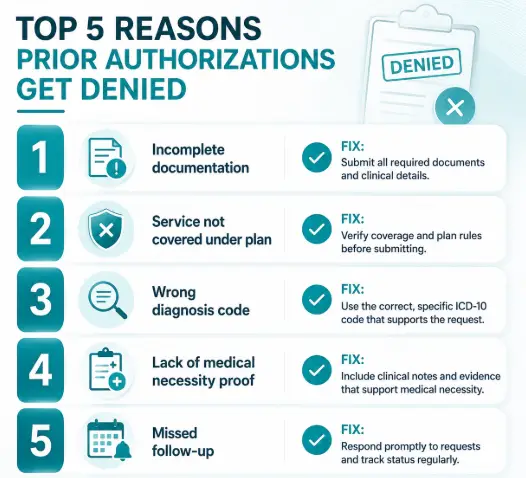
- Top 5 denial reasons
- Most problematic payers
- Staff productivity by team member
- Action plans for improvement
Regional Advantages: Navigating Prior Auth in the DFW Metroplex
Unique DFW Healthcare Landscape Considerations
Multi-System Coordination:
- Major health systems: Baylor Scott & White, Texas Health Resources, Medical City, UT Southwestern
- Challenge: Different prior auth protocols across systems
- Solution: Regional ePA standardization initiatives, shared best practices
Wylie-Specific Benefits:
- Suburban growth: Newer practices can implement modern systems from the start
- Dallas proximity: Access to specialized prior auth service providers
- Regional payers: Familiarity with local/regional insurance plans
Insurance Market Considerations:
- High Blue Cross Blue Shield penetration in DFW
- Growing Medicare Advantage enrollment (54% of Medicare beneficiaries)
- Large employer plans with unique prior auth requirements
- Medicaid managed care with multiple MCO options
Best Practices for DFW Providers
Leverage Regional Resources:
- Join North Texas healthcare associations for payer negotiation power
- Participate in DFW health information exchange for care coordination
- Attend local healthcare IT conferences for technology education
- Network with peers to share payer-specific insights
Build Multi-System Relationships:
- Establish referral protocols that accommodate prior auth workflows
- Coordinate with specialists across DFW for streamlined approvals
- Participate in regional quality initiatives that may influence payer policies
Stay Current on Texas Regulations:
- Monitor Texas Department of Insurance bulletins
- Join Texas Medical Association for advocacy and updates
- Follow Texas Health and Human Services Medicaid updates
Helping Patients Navigate Prior Authorization
What Patients Should Understand
The Basics:
- Prior authorization is an insurance requirement, not a provider choice
- It’s designed to ensure medical necessity and appropriate use
- NOT all services require prior auth – preventive care usually doesn’t
- Providers cannot bypass the requirement
Timeline Expectations:
- Standard decisions: 7-14 days (improving to 7 days under new rules)
- Urgent needs: 72 hours
- Delays happen: Missing information, payer backlogs, complex cases
- Denials can be appealed: Most appeals are successful
What Patients Can Do:
- Verify coverage before scheduling when possible
- Ask about prior auth requirements at scheduling
- Respond quickly if additional information is needed
- Follow up if not hearing back within expected timelines
- Understand financial responsibility if authorization is denied
Patient Communication Best Practices
At Scheduling:
- Inform patients if prior auth is required
- Provide estimated timeline for approval
- Explain what happens if denied
- Set expectations for follow-up communication
During Waiting Period:
- Send status updates at key milestones
- Proactively communicate any delays
- Provide patient portal access for self-service status checks
- Offer contact information for questions
Upon Approval:
- Notify patient immediately
- Proceed with scheduling/treatment
- Confirm any cost-sharing responsibilities
If Denied:
- Explain denial reason in plain language
- Outline appeal process and timeline
- Discuss alternative options if available
- Provide financial counseling if patient will be responsible for costs
Patient Portal Features:
- Real-time prior auth status visibility
- Educational resources about the process
- Secure messaging for questions
- Notifications when status changes
Case Studies: Real-World Prior Auth Transformation
Case Study 1: Family Practice, Wylie, TX
Profile:
- 4 physicians
- 250 prior authorizations monthly
- Mix of commercial, Medicare Advantage, Medicaid
Challenges:
- 2 medical assistants spending 80% of time on prior auth
- 18% denial rate
- Average 6-day approval time
- Frequent patient complaints about delays
Solution Implemented:
- Electronic prior authorization software with EHR integration
- Dedicated prior auth specialist hired
- Standard workflows documented
- Monthly payer performance reviews
Results After 12 Months:
- Staff time reduced by 65% (from 160 hours/month to 56 hours/month)
- Denial rate dropped to 7% (11-point improvement)
- Average approval time: 2.8 days (52% improvement)
- Patient complaints decreased 74%
- ROI achieved in 9 months
- Annual savings: $67,000 (net after technology costs)
Case Study 2: Orthopedic Specialty Group, Dallas, TX
Profile:
- 12 surgeons
- 800+ prior authorizations monthly (high imaging and surgical volume)
- Predominantly commercial insurance
Challenges:
- 4 full-time staff overwhelmed with volume
- 25% denial rate for MRI prior auths
- Surgical delays averaging 12 days
- Revenue cycle impact: $340,000 in pending auths at any time
Solution Implemented:
- Specialized orthopedic prior auth software
- Clinical decision support for imaging appropriateness
- Payer-specific surgical submission templates
- Outsourced appeals management
Results After 18 Months:
- Approval rate increased to 89% (14-point improvement)
- MRI prior auth turnaround: 24-48 hours (was 5-7 days)
- Surgical delays reduced to 4 days average
- Pending auth revenue reduced to $120,000 (65% improvement)
- Added capacity to handle 15% volume growth without additional staff
- ROI: 280% over 18 months
Case Study 3: Community Hospital, Fort Worth, TX
Profile:
- 250-bed hospital
- 15,000+ prior authorizations annually
- Mix of inpatient, outpatient, emergency services
Challenges:
- Decentralized prior auth across departments
- Inconsistent processes and quality
- High denial rate (32%) for inpatient admissions
- Physician dissatisfaction with administrative burden
Solution Implemented:
- Centralized prior authorization department (8 FTE staff)
- Enterprise ePA software with EHR integration
- Real-time clinical decision support
- Physician liaison program for education
- Predictive analytics for high-risk denials
Results After 24 Months:
- Denial rate dropped to 12% (20-point improvement)
- $4.2 million in prevented denials annually
- Physician satisfaction improved 41% (prior auth-specific survey)
- Days in A/R reduced by 8 days system-wide
- Case management efficiency improved allowing focus on complex patients
- ROI: 420% including prevented denials
Your Action Plan: Transform Your Prior Authorization Process
The data is overwhelming: prior authorization is crushing practices financially and clinically. But the solution is within reach. Modern technology and smart processes can reclaim your time, your revenue, and your sanity.
Immediate Actions (This Week):
Assess Your Current State – Day 1:
- Pull data on prior authorizations for the past 3 months (volume by payer, procedure, approval rate)
- Survey staff about time spent on prior auth activities
- Calculate your estimated annual cost using the formula below
- Identify your top 5 pain points
Quick Cost Calculator:
Annual Prior Auth Cost =
(Weekly PA Volume × 52 weeks × Hours per PA × Staff Hourly Rate)
+ (Denied PAs × Appeal Cost per PA)
+ (Delayed Revenue × Opportunity Cost)
Example for 5-physician practice:
(225 PAs/week × 52 × 2 hrs × $25/hr) = $585,000
+ (60 denials/month × 12 × $200) = $144,000
+ ($85,000 × 5% opportunity cost) = $4,250
= $733,250 annual cost
Identify Quick Wins – Day 2:
- Review highest-volume procedures and identify automation opportunities
- Check if your EHR has unused prior auth features
- Create a list of frequently denied procedures to target
- Document current workflow to identify obvious bottlenecks
Research Technology Solutions – Day 3:
- Identify 3-5 ePA software vendors that integrate with your EHR
- Request demos focused on your specific pain points
- Check references from similar-sized practices
- Get pricing and ROI projections
Engage Your Team – Day 4:
- Hold staff meeting to discuss prior auth challenges
- Assign ownership for improvement initiative
- Set initial improvement goals (e.g., reduce denial rate by 10%)
- Create communication plan for ongoing updates
Build Your Business Case – Day 5:
- Compile cost analysis and projected savings
- Document patient impact stories
- Calculate ROI for technology investment
- Present to leadership for approval
Short-Term Initiatives (This Month)
Process Documentation – Week 1:
- Document current state workflows with flowcharts
- Identify every step, decision point, and potential failure
- Time each step to quantify inefficiencies
- Survey staff on biggest frustrations
Quick Improvements – Week 2:
- Implement simple process changes (batch processing, templates)
- Create payer-specific quick reference guides
- Set up tracking spreadsheet for key metrics
- Establish daily huddle to review pending prior auths
Technology Selection – Week 3:
- Complete software demos with cross-functional team
- Evaluate integration capabilities and payer coverage
- Check vendor references and case studies
- Select vendor and begin contract negotiation
Pilot Planning – Week 4:
- Select 1-2 high-volume procedures for pilot
- Define success metrics and baseline performance
- Create implementation timeline
- Assign team roles and responsibilities
Medium-Term Goals (Next 3-6 Months)
Implementation for Months 1-2:
- Install and configure ePA software
- Complete EHR integration and testing
- Train all staff on new system and workflows
- Launch pilot with selected procedures
- Monitor daily and adjust as needed
Expansion for Months 3-4:
- Roll out to all procedures and payers
- Implement clinical decision support tools
- Deploy patient portal for status tracking
- Refine workflows based on data
Optimization for Months 5-6:
- Analyze 6-month performance data
- Identify remaining improvement opportunities
- Expand payer API connections
- Document lessons learned and best practices
- Celebrate wins with the team
Long-Term Vision (6-12 Months and Beyond)
Advanced Capabilities for Months 6-12:
- Implement predictive analytics for denial prevention
- Develop specialty-specific workflows
- Build strategic payer relationships
- Train staff on CMS 2026 requirements
Leadership and Innovation for Year 2:
- Participate in regional prior auth improvement initiatives
- Share your success story with peers
- Explore AI-powered clinical decision support
- Position for value-based care contracts
Industry Resources:
- American Medical Association (AMA): Prior authorization advocacy and research
- Centers for Medicare & Medicaid Services (CMS): Federal regulation updates
Stop Losing Time and Money Today
You’ve seen the numbers. You’ve lived the frustration. Now it’s time to act.
Every week you wait costs your practice:
- 55+ hours of clinical staff time on bureaucratic busy work
- $15,000-$25,000 in administrative costs
- 15-30 patient delays causing clinical deterioration and dissatisfaction
- Immeasurable physician burnout driving talented providers out of medicine
The choice is clear:
- Continue drowning in prior authorization paperwork
- OR invest in solutions that generate 3-5x ROI while improving patient care
Get Expert Help from Integrate Point
We specialize in helping Texas healthcare providers optimize their prior authorization and revenue cycle processes.
Our Prior Authorization Services:
Technology Implementation:
- Electronic prior authorization software selection and deployment
- EHR integration ensuring seamless workflows
- Payer API connectivity maximizing automation
- Patient portal configuration for transparency
Process Optimization:
- Current state workflow assessment
- Bottleneck identification and elimination
- Standard operating procedure development
- Staff training and change management
Managed Services:
- Dedicated prior authorization specialists handling your volume
- Appeals management with proven success rates
- Payer relationship management
- Continuous monitoring and optimization
Compliance Support:
- CMS 2026 API readiness assessment
- FHIR implementation guidance
- State regulation compliance (Texas-specific)
- Ongoing regulatory monitoring
Schedule Your Free Prior Authorization Assessment
What you’ll receive in your complimentary consultation:
- Volume and cost analysis: We’ll quantify exactly how much prior auth is costing you
- Process audit: Identify inefficiencies and improvement opportunities
- Technology assessment: Evaluate your current systems and gaps
- Custom roadmap: Prioritized recommendations with ROI projections
- Implementation timeline: Clear path from current state to optimized operations
This 90-minute consultation includes:
- Review of your prior auth metrics from the past 6 months
- Staff interview to understand pain points
- Benchmarking against industry best practices
- Technology recommendations for your specific EHR and payer mix
- Projection of potential time and cost savings
- No-obligation discussion of how we can help
Limited-Time Offer: Free Prior Auth Process Audit
For the next 60 days, we’re offering comprehensive prior authorization audits at no charge.
What’s included ($3,500 value):
- 6-month prior auth data analysis (volume, approvals, denials, timelines)
- Staff time study and cost calculation
- Technology readiness assessment for CMS 2026 requirements
- Payer-specific performance analysis
- Custom ROI projection for automation solutions
- Written report with prioritized action plan
- 90-day implementation support roadmap
To qualify:
- Texas-based practice with 3+ providers
- Minimum 50 prior authorizations monthly
- Commit to 3-hour onsite or virtual assessment
- Ready to implement improvements within 6 months
Take Control of Your Prior Authorization Process
Modern technology and proven processes can transform prior authorization from a nightmare into a streamlined, efficient operation that serves both your practice and your patients.
Don’t let another week go by watching:
- Staff spend hours on hold
- Patients deteriorate waiting for approval
- Revenue sit frozen in pending authorizations
- Physicians burn out from administrative burden
The Time to Act is NOW
Prior to the January 2026 CMS deadline:
- You need ePA systems in place
- Staff trained on new workflows
- Payer connections established
- Processes optimized for 72-hour urgent decisions
Practices that start now will:
- Have smooth implementations without last-minute chaos
- Realize benefits for 12-18 months before the mandate
- Be positioned as industry leaders
- Attract patients and providers with modern systems
Practices that wait will:
- Rush implementation in late 2025
- Miss out on 18 months of potential savings
- Struggle with technical and workflow issues
- Fall behind competitors
About Integrate Point
Integrate Point is a leading healthcare technology and consulting firm specializing in revenue cycle optimization, prior authorization management, and referral coordination for practices throughout Texas and the United States. Our solutions help providers reduce administrative burden, improve patient access, and achieve sustainable financial performance.
Your Next Step
Stop letting prior authorization drain your revenue.
Get a free prior authorization audit and uncover where your practice is losing time, money, and patients—before CMS 2026 mandates take effect.

Awesome blog.
Normally I do not read article on blogs, however I would like to say that this write-up very forced me to check out and do it! Your writing taste has been amazed me. Thanks, very great article.