There is a moment most healthcare outsourcing companies know well. The service is solid. The team is trained. The results are there. But the phone is not ringing the way it should. New clients come in slowly, mostly through referrals and word of mouth, and growth feels like it depends entirely on who you happen to know.
That is not a service problem. That is a visibility problem. And digital marketing for healthcare services is exactly what closes that gap.
This guide walks through how companies offering prior authorization outsourcing and healthcare virtual assistant services can build a digital ad strategy that reaches the right decision makers, generates qualified leads, and turns online visibility into real revenue growth across Texas and beyond.
Why Healthcare Outsourcing Companies Cannot Afford to Ignore Digital Advertising
The healthcare administrative outsourcing market is growing fast. Clinics are overwhelmed. Prior authorization backlogs are getting longer. Front desk staff are stretched thin. And practice managers are actively searching online for companies that can take that weight off their teams.
According to Google Health, healthcare decision makers conduct an average of 12 online research sessions before contacting a vendor. That means your future clients are already out there, searching, comparing, and evaluating. The question is whether your company shows up when they look.
Without a structured digital strategy, the answer is usually no. And the clients who could have been yours go to whoever was visible instead.
Who Is Actually Searching for Prior Authorization and VA Services
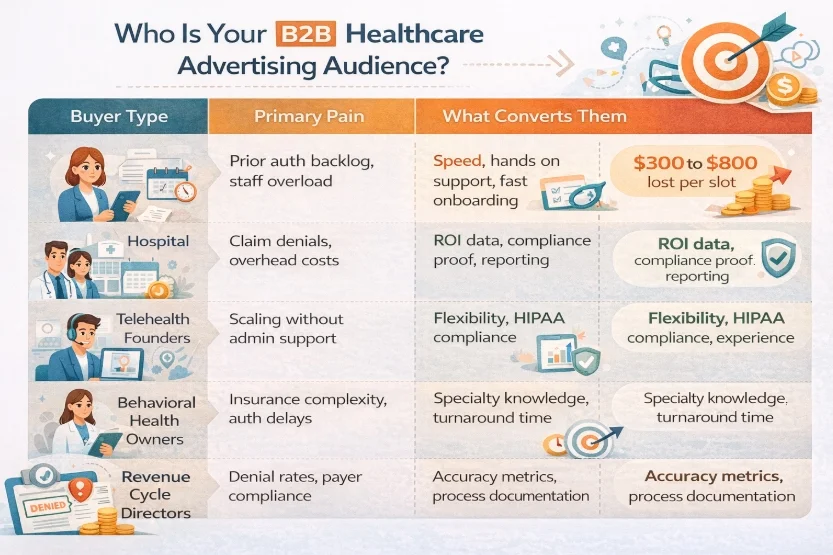
Before any ad goes live, you need to know exactly who is on the other side of the screen. For prior authorization outsourcing and healthcare virtual assistant services, the buyers are not patients. They are busy professionals making operational decisions under significant pressure.
Practice managers at multi provider clinics are drowning in prior authorization requests, insurance follow-ups, and claim denials. They need relief and they need it fast. Hospital administrators are focused on overhead reduction and revenue cycle performance. They think in numbers and they respond to proof.
Telehealth founders and behavioral health practice owners are scaling quickly but building admin infrastructure from scratch. They are open to outsourcing but cautious about trust and compliance.
Each of these buyers searches differently, responds to different messages, and needs to see different proof before they pick up the phone. A strategy that treats them all the same will reach none of them effectively.
Google Ads for Medical Practices: Capturing Buyers at the Right Moment
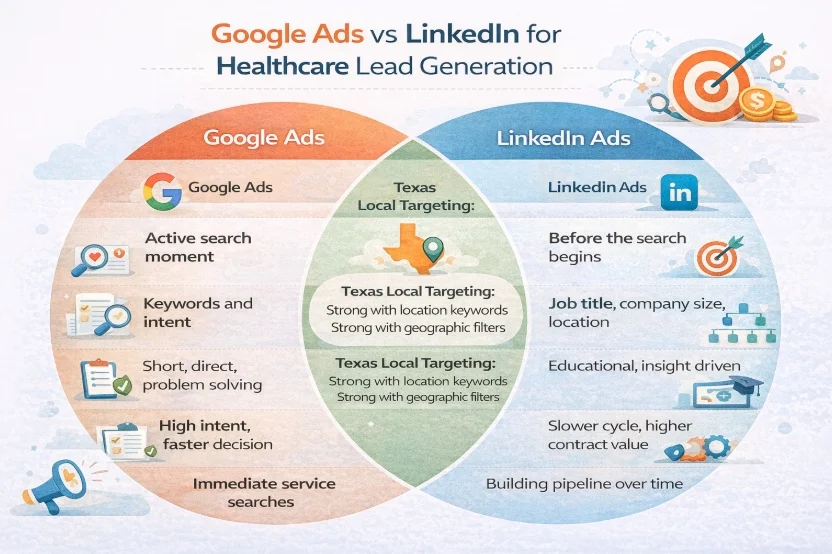
Google ads for medical practices and outsourcing services work because they meet decision makers exactly when they are actively looking for a solution. Nobody searches “prior authorization outsourcing Texas” unless they genuinely need it. That intent is worth more than almost any other signal in digital marketing.
The keywords that convert best in this space are specific and problem driven. Search terms like “prior authorization services Texas,” “healthcare virtual assistant company,” and “medical billing outsourcing” all come from buyers who are close to making a decision. They are not browsing. They are ready to act.
According to Google Ads Help, healthcare service ads perform best when the landing page matches the exact language of the search term. If someone searches “prior authorization outsourcing” and lands on a generic homepage, they leave immediately. If they land on a page that speaks directly to their problem and how you solve it, they stay and they convert.
Keep ad copy short, direct, and problem specific. One clear pain with clear solution. One clear next step. That is the formula that works in healthcare paid search.
LinkedIn Marketing for Healthcare: Reaching Decision Makers Before They Search
Google catches buyers when they are searching. LinkedIn reaches them before they even know they need you. That is a completely different kind of opportunity, and it requires a different kind of message.
LinkedIn marketing for healthcare works because the targeting is extraordinarily precise for B2B healthcare advertising. You can put a sponsored post directly in front of every revenue cycle manager at a multi provider clinic in Texas without spending a dollar reaching anyone outside that exact profile.
According to LinkedIn Marketing Solutions, healthcare decision makers engage with thought leadership content at significantly higher rates than with direct promotional ads. A post explaining the three most common reasons prior authorization gets delayed will outperform “hire us” messaging every single time.
Lead generation forms on LinkedIn let interested decision makers submit contact details without leaving the platform. Pair a strong educational post with a downloadable prior authorization workflow guide and conversion rates climb significantly without increasing ad spend.
Healthcare Content Marketing: The Strategy That Works After the Budget Runs Out
Paid ads stop the moment the budget runs out. Content keeps working for months and years after it is published. For companies offering prior authorization outsourcing and healthcare virtual assistant services, a strong healthcare content marketing strategy is one of the highest return investments available.
The content that performs best in this space answers the exact questions your buyers are typing into Google. Questions like “how do I reduce prior authorization denials,” “what does a healthcare virtual assistant handle,” and “how much does prior authorization outsourcing cost” all represent real searches from real buyers at different stages of their decision.
According to HHS.gov, healthcare organizations increasingly rely on digital resources to evaluate vendors before making purchasing decisions. Being the company that answers those questions consistently builds trust before the first conversation ever happens.
Blog posts, case studies, workflow guides, and educational videos all contribute to a content library that generates healthcare lead generation passively every single month.
Telehealth Marketing Strategy: A Growing Audience You Cannot Ignore
Telehealth is one of the fastest growing segments in healthcare right now. And telehealth platforms have some of the most acute administrative challenges of any practice type. Prior authorization requirements for virtual visits are complex. Insurance verification across multiple states is time consuming. And the teams running these platforms are usually leaning and moving fast.
A focused telehealth marketing strategy for prior authorization and virtual assistant services taps directly into that pain. Telehealth founders are active on LinkedIn, they consume digital content heavily, and they make decisions faster than traditional hospital administrators.
According to HHS.gov telehealth resources, the number of telehealth providers in the US has grown dramatically since 2020 and administrative complexity has grown alongside it. That growth represents a significant and underserved audience for prior authorization outsourcing services.
Content that speaks directly to the telehealth experience, multi state prior authorization challenges, virtual visit insurance verification, and remote team management, will outperform generic healthcare messaging every time with this audience.
Retargeting: Staying Visible Through the Long Healthcare Decision Cycle
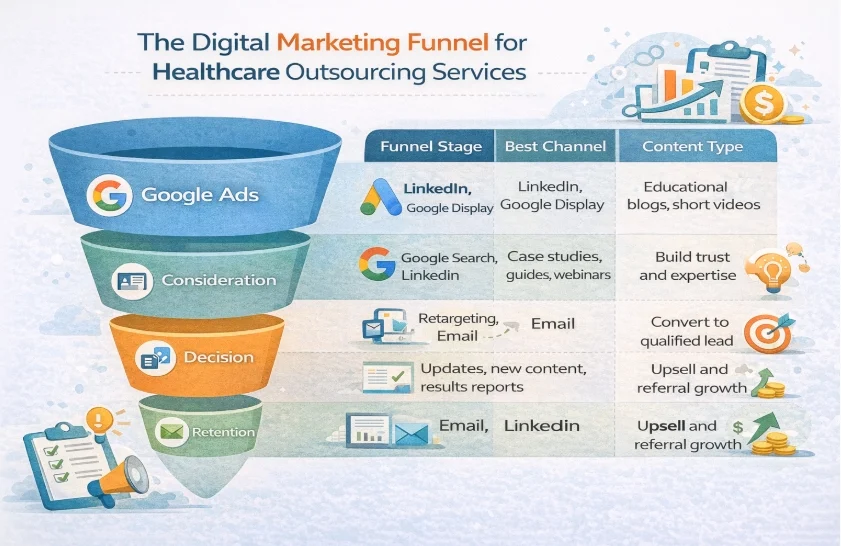
Healthcare B2B advertising decisions are not made quickly. A practice manager might read your blog in January, bookmark your services page in February, and not be ready to reach out until April. Retargeting keeps your brand visible throughout that entire process.
The key to retargeting in B2B healthcare advertising is message sequencing. Someone who visited your prior authorization services page should see an ad specifically about prior authorization. Someone who downloaded a workflow guide should see an offer for a free consultation. The message should always match where they are in the decision process.
According to Google Marketing Platform, retargeted visitors convert at significantly higher rates than cold traffic. In healthcare outsourcing marketing where decision cycles stretch across weeks and months, retargeting is what keeps your company top of mind when the buyer is finally ready to act.
Landing Pages: Where Your Ad Budget Either Works or Disappears
Every digital marketing for healthcare services campaign lives or dies on the landing page. The most targeted ad in the world cannot save a page that fails to communicate value within the first five seconds of a visitor arriving.
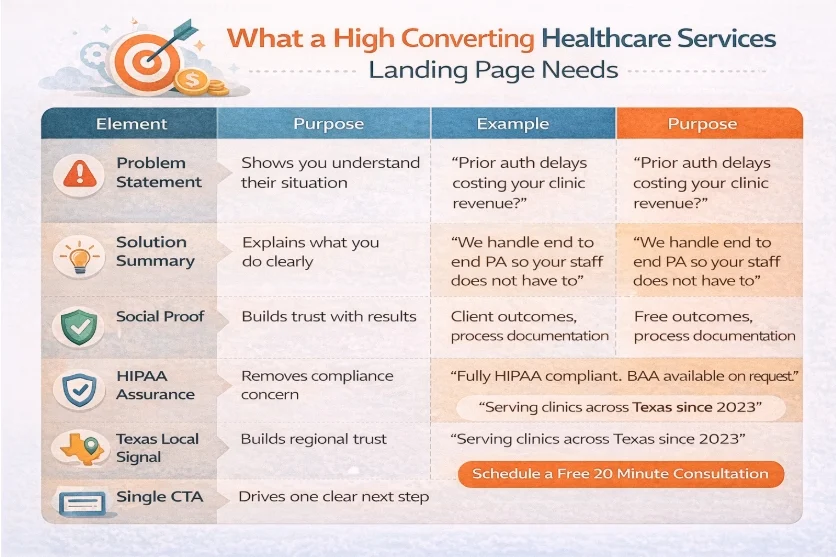
A strong healthcare landing page does five things consistently. It names the exact problem the visitor came with. Explain how you solve it clearly and quickly. Shows the proof that you have solved it before through results, testimonials, or process documentation. Removes the risk of saying yes by offering a free consultation or assessment. And presents one single clear call to action with no competing options.
According to HubSpot Marketing Research, landing pages with a single focused call to action convert at significantly higher rates than pages with multiple competing options. In prior authorization services Texas campaigns especially, where local trust matters, adding a Texas specific reference on the landing page improves conversion rates further.
Video Ads: Building Trust Before the Sales Call
Healthcare buyers are cautious. They are not buying a software subscription they can cancel next month. They are trusting you with their administrative operations, their patient data, and their revenue cycle. That level of trust takes more than a clever headline to build.
Short videos that show how your prior authorization process works, what your healthcare virtual assistant services handle on a daily basis, and what results your clients see do more to build that trust than any written ad. YouTube, LinkedIn, and Instagram reels are all effective platforms for this content.
According to the American Marketing Association, video content generates significantly higher engagement rates in B2B healthcare marketing compared to static image ads. A two-minute walkthrough of how your team handles a prior authorization denial will be watched by exactly the decision maker you want to reach.
Frequently Asked Questions
Digital marketing for healthcare services means using online channels including Google ads, LinkedIn, content marketing, and retargeting to reach clinic managers, hospital administrators, and telehealth founders who need prior authorization outsourcing or healthcare virtual assistant services. It focuses on reaching the right decision maker at the right moment in their buying journey.
Google ads for prior authorization outsourcing capture decision makers at the exact moment they are searching for a solution. Targeting problem driven keywords puts your company in front of buyers with active intent, which means faster conversions and lower wasted spend compared to broad awareness campaigns.
LinkedIn allows precise targeting by job title, company size, industry, and location. For B2B healthcare advertising, this means reaching every practice manager or revenue cycle director in Texas without spending on irrelevant audiences. Educational content performs best because healthcare buyers respond to expertise and proof before they respond to promotional messaging.
Content that answers real questions buyers are searching for drives the strongest healthcare leads. Blog posts about reducing prior authorization denials, guides explaining what healthcare virtual assistant services handle, and case studies showing measurable results all attract decision makers who are actively researching and close to making a purchasing decision.
Telehealth founders move faster, consume more digital content, and face unique administrative challenges around multi state prior authorization and virtual visit insurance verification. A telehealth marketing strategy speaks directly to those specific pain points rather than using generic healthcare messaging, which dramatically improves both engagement rates and lead quality.
How Integrate Point Builds Digital Marketing for Healthcare Services in Texas
At Integrate Point, we help clinics, hospitals, behavioral health practices, and telehealth platforms across Texas build digital marketing strategies that generate real qualified leads for prior authorization and virtual assistant services.
We understand that healthcare lead generation in this space requires more than running ads. It requires knowing the buyer, understanding the compliance environment, and speaking directly to the operational problems your audience is dealing with every single day.
From Google ad campaigns targeting prior authorization services Texas searches to LinkedIn content strategies built for revenue cycle directors, our team brings both the marketing expertise and the healthcare industry knowledge to make every campaign count.