
Your practice has good doctors, a staff that cares, and patients who trust you. But nobody knows you exist.
That’s the reality for thousands of medical practices. Being a great doctor doesn’t automatically fill your schedule. People have to find you first. And in 2026, most people start their search online.
This is where healthcare digital marketing strategies matter. Not just SEO or Google Ads or social media in isolation. Real strategies that work together to attract patients, build trust, and grow your practice.
If you’re in Dallas, Texas, or anywhere else, the problem is the same. Patients need you. They’re searching for you. But they’re finding your competitors instead. That stops today.
Let me show you exactly which digital marketing channels attract new patients to medical practice, and why they work.
Key takeaways:
- SEO for doctors brings organic patient searches within 3-6 months
- Google Ads captures urgent patient needs with fast ROI
- Medical practice website design converts visitors into appointments
- Healthcare digital marketing strategies must be integrated across channels
- Increase online visibility through consistent local optimization
- Website conversion rate is more important than traffic
- Measure results and adjust based on data monthly
Understanding Healthcare Digital Marketing Strategies
Healthcare digital marketing strategies are fundamentally different from other industries. You’re not selling products. You’re building trust with people who need medical care.
Patients researching healthcare are anxious. They’re making important health decisions. They need clear information. They need to know if your practice is real, professional, and trustworthy.
Effective healthcare digital marketing strategies address this anxiety. They provide information, showcase your expertise, and make it easy for patients to find you and schedule appointments.
The best part? This works faster than you think. Practices implementing solid digital marketing strategies to see new patient appointments within 30 to 60 days.
What Digital Marketing Channels Work for Attracting Patients
Not all channels are equal. Some drive lots of traffic but few actual patients. Others cost more but deliver better results.
Search Engine Optimization (SEO) for doctors
SEO for doctors is where most practices should start. When someone searches for a “cardiologist near me” or “pediatrician accepting new patients,” they’re looking for you.
SEO for healthcare means your website appears in those search results. It’s not about paying for every click. It’s about being found naturally when patients are actively searching for your specialty.
A good SEO strategy includes several parts. Your website needs to be technically sound, your content needs to answer actual patient questions, and your online presence needs to stay consistent across directories and review sites.
Practices in Dallas, Houston, and San Antonio that invested in SEO for doctor’s report 40% to 60% increases in website traffic within six months. That traffic converts into new patients.
Google Ads for Doctors
Google Ads for doctors works differently than organic SEO. You pay per click. Someone searches for your specialty. Your ad appears. They click. You pay.
It sounds expensive, but the math works. If you’re getting $500 per new patient appointment, and Google Ads costs you $150 per click with a 33% conversion rate, you’re paying $450 per patient. That’s profitable.
Google Ads for doctors works best for services that are time sensitive. Someone needs urgent care. Someone just moved and needs a new physician. They search and find your ad immediately.
Healthcare Website Design
Your website is your practice’s digital front door. Medical practice website design needs to accomplish specific things.
Patients land on your site. They need to immediately understand what services you offer, know your location, hours, and how to schedule. They need to see that you’re professional and trustworthy.
Healthcare website design also needs to work on phones. Most patients search and schedule appointments on mobile devices. If your website looks terrible on phones, patients leave.
A good medical practice website design includes patient education content, staff bios, patient testimonials, and clear appointment scheduling. It loads fast, looks professional and makes scheduling easy.
SEO Services for Healthcare
SEO services for healthcare go beyond just keywords. Professional SEO services for healthcare include technical optimization, content strategy, local optimization, and ongoing monitoring.
Local SEO matters enormously for medical practices. When someone searches “dermatologist in Wylie” or “family medicine in Dallas,” they want someone close. Local SEO gets your practice in front of those searches.
SEO services for healthcare providers include Google Business Profile optimization, local directory submissions, and location-specific content. This combination helps patients find you when they’re actively searching.
Building an Integrated Approach
The practice of seeing the best results aren’t using just one channel. They’re using integrated marketing strategies.
SEO brings in organic traffic. Google Ads captures urgency. Your medical practice website design converts visitors into patients. Telemedicine advertising reaches patients interested in virtual care.
An integrated marketing agencies approach means all channels work together. Your messaging is consistent. Your branding is strong. Patients see you across multiple touchpoints before scheduling.
Medical Advertising Agency: When to Get Help
Building digital marketing strategies requires expertise. A medical advertising agency understands healthcare regulations. They know HIPAA compliance. They understand what messaging resonates with patients.
Some practices build strategies in-house. Many get help from a medical advertising agency that specializes in healthcare.
The investment typically pays off quickly. A good medical advertising agency brings structure, expertise, and accountability. They measure the results, adjust strategies based on data. They focus on patient acquisition and conversion.
Telemedicine Advertising: Reaching Digital-First Patients
Telemedicine advertising matters more every year. Patients want virtual visits when possible. Your practice needs to be visible for telemedicine searches.
Telemedicine advertising includes Google Ads, social media, and content marketing focused on virtual care. Message patients that you offer virtual consultations. Show how easy it is. Make scheduling simple.
Measuring What Actually Works
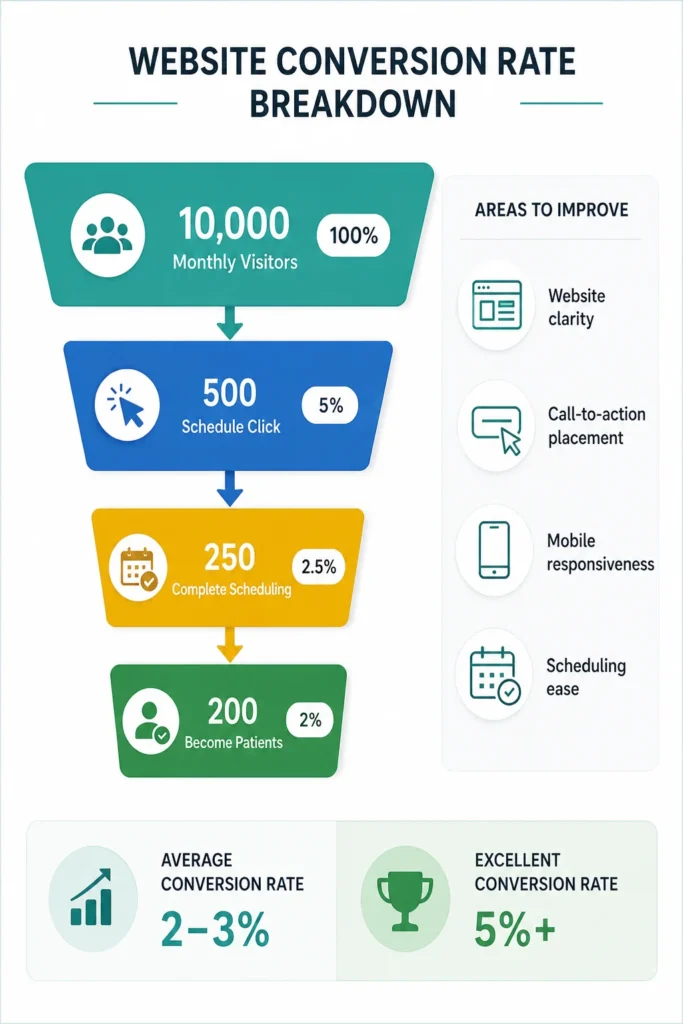
Website conversion rate matters more than traffic. You can have 10,000 monthly website visitors and zero new patients. Or 500 visitors converting into 50 new patients.
Track your website conversion rate carefully. What percentage of visitor’s schedule appointments? If it’s below 2%, your website design or messaging needs improvement.
Track which channels drive the best patients. Google Ads might bring quantity. SEO might bring better-qualified patients. Telemedicine might attract specific demographics. Measure and double down on what works.
Getting Started: A 90-Day Action Plan
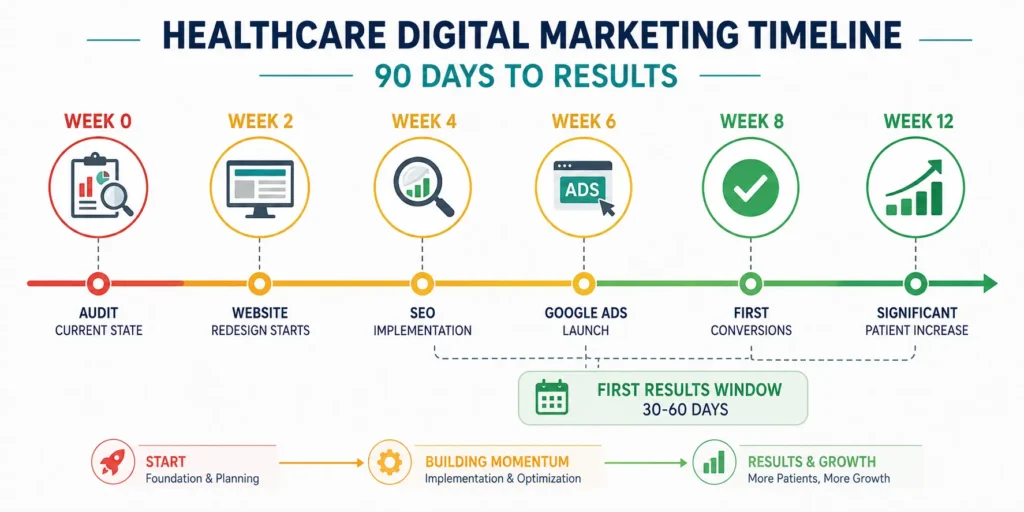
Month 1: Foundation
Audit your current online presence. What is your website conversion rate? Where do you rank for important keywords? What are competitors doing?
Month 2: Implementation
Fix your medical practice website design. Optimize local SEO for doctors. Set up Google Ads testing.
Month 3: Measurement
Track results. Measure website conversion rate. Count new patient appointments from each channel. Identify what is working.
SEO for doctors, Google Ads, medical practice website design, and telemedicine advertising work best together. SEO brings organic traffic. Google Ads captures urgency. Your website design converts visitors. Telemedicine advertising reaches digital-first patients. Integration matters more than individual channels.
Invest in SEO services for healthcare, optimize your Google Business Profile, and ensure your medical practice website design is mobile-friendly. Local SEO for doctors puts you in front of patients searching nearby. Consistent directory submissions across healthcare platforms amplify visibility.
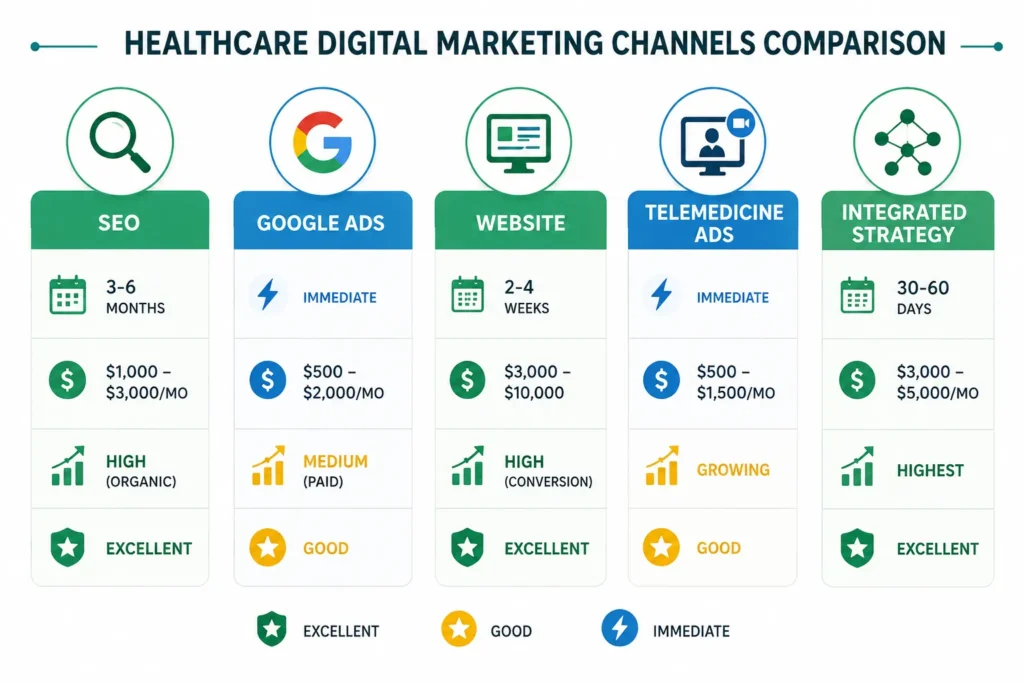
Cost varies based on services. SEO for doctors typically runs $1,000-$3,000 monthly. Google Ads depends on competition and budget. Website redesign costs $3,000-$10,000. Integrated services through a medical advertising agency bundling everything typically cost $3,000-$5,000 monthly.
2-3% conversion rate is average. Excellent is 5%+. Track how many website visitors schedule appointments. If conversion is below 2%, your medical practice website design or messaging needs improvement.
Yes, if you offer telehealth. Telemedicine advertising reaches patients preferring virtual visits. Use Google Ads and social media to promote virtual consultations. Message the convenience and accessibility.
SEO for doctors takes 3-6 months. Google Ads shows results immediately. Website redesign impacts conversion within weeks. Most practices see new patient growth within 30-60 days of implementing comprehensive healthcare digital marketing strategies.
Your Trusted Digital Marketing Partner
Healthcare digital marketing strategies work when they’re implemented thoughtfully. Increase online visibility through SEO for doctors and Google Ads. Medical practice website design converts visitors into patients. Integrated marketing agencies bring expertise and accountability.
Integrate Point helps medical practices in Texas and nationwide build healthcare digital marketing strategies that attract patients. We combine SEO services for healthcare, medical practice website design, and Google Ads expertise into one cohesive approach. Your practice gets seen, website converts. Your schedule fills. We handle the digital marketing complexity, so you focus on medicine. Let’s build a strategy that works for your practice.