
The Crisis: 68% of specialist referrals never reach completion, costing the average clinic $150,000-$300,000 per year in lost revenue while your patients wait 23+ days for specialist appointments that should take 5 days.
The Referral Breakdown: Why Your Clinic Is Bleeding Money
For Clinic Managers & Healthcare Administrators:
- 30-40% of referrals are never completed due to process breakdowns
- Average revenue loss: $125-$180 per incomplete referral
- Insurance claim denials: 23% rejection rate for referral-related issues
- Staff time wasted: 4-6 hours per day managing referral follow-ups manually
For Patients:
- Average wait time: 23 days for specialist appointments (should be 5-7 days)
- 68% of patients experience at least one referral-related issue
- 42% of patients report confusion about referral status
- 1 in 5 patients abandon care completely due to referral delays
The Hidden Cost: Every delayed referral damages your clinic’s reputation and drives patients to competitors who offer seamless coordination.
Why Referrals Fail: The 5 Critical Breakdown Points
1. Manual Paper-Based Tracking (35% of Failures)
The Problem:
- Faxed referrals get lost or arrive illegibly
- No automated follow-up on referral status
- Zero visibility into whether patients actually booked appointments
- Staff manually calling specialists to confirm receipt
Real Cost:
- 2.5 hours per day per staff member on phone follow-ups
- 18% of faxed referrals never reach the specialist office
- $45,000 annually in administrative overhead
2. Incomplete Documentation (28% of Failures)
Common Missing Elements:
- Prior authorization requirements not identified
- Insurance eligibility not verified beforehand
- Clinical notes or test results not attached
- Wrong CPT codes or diagnosis codes
Impact on Claims:
- 67% of denied claims cite missing authorization as primary reason
- Average claim denial costs $25-$117 to appeal and resubmit
- 45-60 day delay in payment when documentation is incomplete
3. Poor Provider-to-Provider Communication (22% of Failures)
Communication Gaps:
- No confirmation when specialist receives referral
- Unclear urgency levels (routine vs. urgent vs. STAT)
- Patient handed printed referral with no tracking
- No feedback loop on patient outcomes
Study Finding: 70% of medical errors stem from referral miscommunication (American Medical Association, 2023)
4. Insurance Authorization Delays (10% of Failures)
Authorization Bottlenecks:
- Prior authorization takes 7-14 days on average
- 29% of prior authorizations are denied initially
- Appeals process adds 30-45 days
- Emergency cases delayed while waiting for approval
Financial Impact:
- $8.4 billion lost annually across U.S. healthcare due to prior auth delays
- Average clinic spends 20 hours per week on authorization calls
5. Lack of Patient Follow-Through (5% of Failures)
Patient-Side Issues:
- Don’t understand why referral is needed
- Can’t afford specialist copay or deductible
- Don’t receive appointment confirmation
- Forget to schedule or miss appointment
Statistic: 42% of patients never schedule the specialist appointment after receiving a referral.
Referral Failure Flowchart
Top 7 Referral-Related Denial Reasons
1. No Prior Authorization (34% of denials)
- Cost per denial: $25-$117 to appeal
- Average appeal time: 45-60 days
- Success rate after appeal: Only 58%
2. Expired or Missing Referral (22% of denials)
- Most referrals expire after 90 days
- No automated alerts for expiring referrals
- Patients seen after expiration = automatic denial
3. Out-of-Network Specialist (18% of denials)
- Patient referred to non-contracted provider
- No real-time insurance verification
- Clinic liable for non-covered services
4. Incorrect Diagnosis Codes (12% of denials)
- ICD-10 codes don’t match referral documentation
- Medical necessity not established
- Requires complete resubmission
5. Service Not Covered by Plan (8% of denials)
- Referral for non-covered procedure
- No benefits verification performed
- Patient receives unexpected bill
6. Duplicate Referral Submission (4% of denials)
- Multiple submissions for same referral
- Billing system errors
- Payment delayed or denied
7. Timely Filing Missed (2% of denials)
- Claims submitted past insurance deadline (typically 90 days)
- No tracking of claim submission dates
The Modern Solution: Digital Referral Management Systems
What a Proper Referral Management System Does
Real-Time Tracking & Alerts
- Instant notification when specialist receives referral
- Automated patient reminders to schedule appointment
- Staff alerts for pending authorizations or missing documentation
- Dashboard showing referral completion rates by specialist
Automated Documentation
- Pre-populates referral forms from EHR
- Attaches relevant clinical notes and test results automatically
- Flags prior authorization requirements before submission
- Generates proper ICD-10 and CPT codes
Insurance Verification
- Real-time eligibility checking
- Prior authorization status tracking
- Network status verification for referred providers
- Coverage limitation alerts
Closed-Loop Communication
- Secure messaging between providers
- Specialist consultation notes returned to PCP
- Patient outcome tracking
- Integration with care coordination platforms
Real Results: What Clinics Actually Achieve
Case Study Outcomes (Healthcare IT Research, 2024)
Mid-Size Primary Care Practice (3 Physicians)
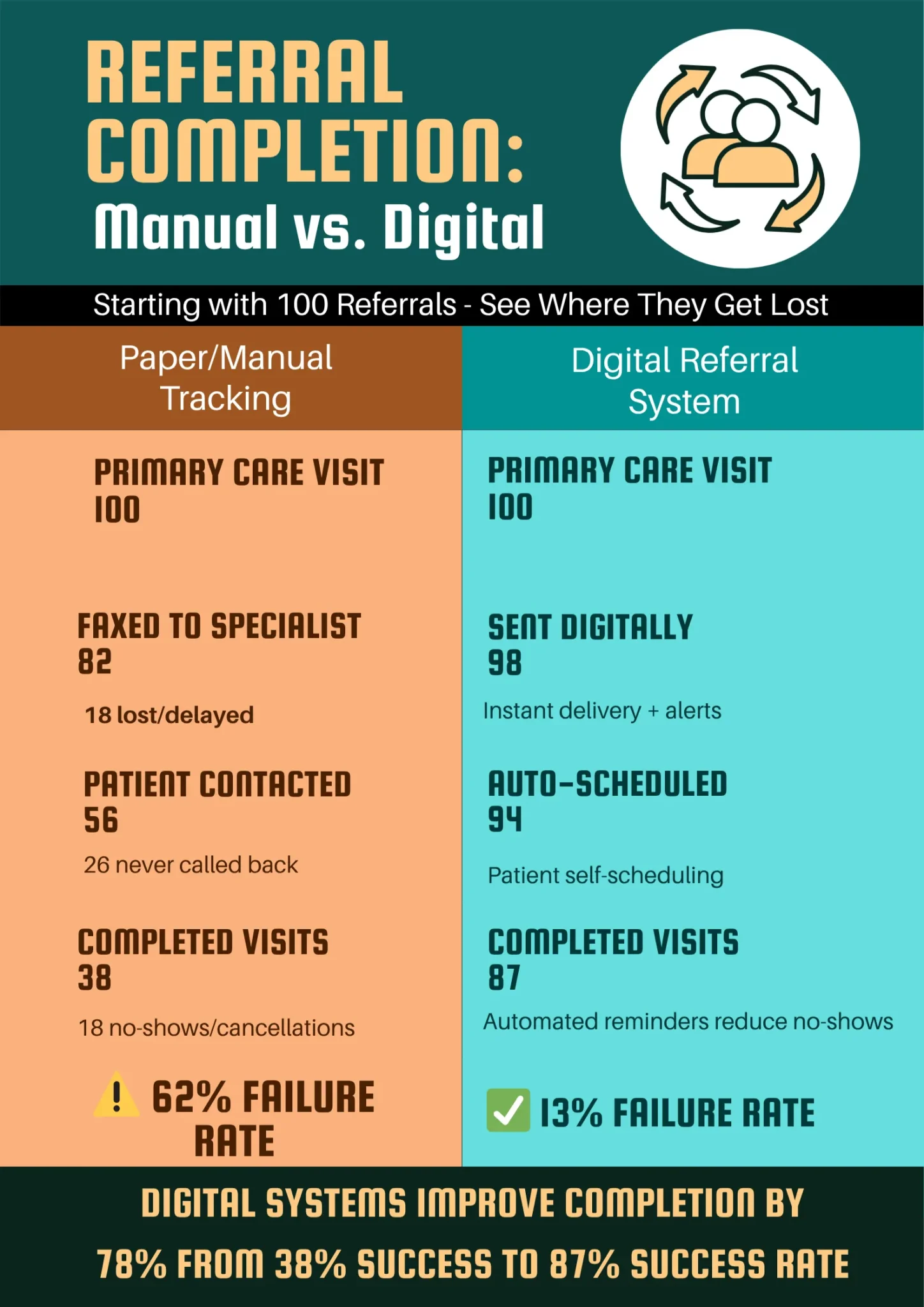
- Before: 520 referrals/month, 38% completion rate
- After: 520 referrals/month, 82% completion rate
- Revenue gain: $185,000 annually
- Staff time saved: 15 hours/week
- Patient satisfaction: Increased from 68% to 91%
Multi-Specialty Clinic (8 Physicians)
- Reduced claim denials: From 24% to 7%
- Prior auth approval time: From 12 days to 4 days
- Appeal volume: Reduced by 73%
- Annual savings: $340,000
Hospital-Based Outpatient Clinic
- Referral leakage prevented: $425,000 annually
- Specialist coordination improved: 65% to 94%
- Patient no-show rate: Decreased from 22% to 9%
Key Finding: Clinics implementing digital referral systems see ROI within 6-9 months and save an average of $280,000 annually.
Critical Features to Look for in Referral Software
Must-Have Capabilities
Integration Requirements
- Bidirectional EHR integration (Epic, Cerner, Athenahealth, etc.)
- Claims management system connectivity
- Patient portal integration
- Specialist network connectivity
Compliance & Security
- HIPAA-compliant messaging
- Audit trails for all referral activities
- Encrypted data transmission
- Role-based access controls
Analytics & Reporting
- Referral completion rates by specialist
- Average time-to-appointment metrics
- Denial rate trending
- Revenue cycle impact reports
- Leakage analysis (patients going out of network)
Patient Experience Tools
- Automated appointment reminders (text, email, phone)
- Self-scheduling capabilities
- Referral status tracking portal
- Financial counseling integration
How Referral Delays Destroy Patient Satisfaction
The Patient Perspective
What Patients Experience:
- 23-day average wait for specialist appointment
- No status updates after receiving referral
- Confused about next steps (42% of patients)
- Unexpected bills from authorization issues
- Repeat tests due to poor information transfer
Impact on Patient Loyalty:
- 28% of patients switch providers after poor referral experience
- Average patient lifetime value: $12,000-$18,000
- Cost of losing 50 patients/year: $600,000-$900,000
CAHPS Score Impact:
- Referral delays lower overall satisfaction scores by 18-24%
- “Access to Specialists” is weighted heavily in value-based contracts
- Poor scores = reduced reimbursements in VBC models
Your 30-Day Referral System Transformation Plan
Audit & Assessment – Week 1:
- Calculate current referral completion rate (target baseline)
- Identify top 10 specialists you refer to most frequently
- Document current average time from referral to appointment
- Calculate monthly denied claims related to referrals
- Survey staff on biggest referral pain points
Vendor Evaluation – Week 2:
- Research 3-5 referral management platforms
- Request demos focused on your workflow
- Check EHR integration compatibility
- Review pricing and ROI projections
- Check references from similar-sized clinics
Implementation Planning – Week 3:
- Select platform and sign contract
- Assign internal project manager
- Schedule staff training sessions
- Map current workflow to new system
- Set up specialist network in platform
Launch & Monitor – Week 4:
- Go-live with pilot group (1-2 providers)
- Monitor completion rates daily
- Address technical issues immediately
- Gather staff and patient feedback
- Plan full rollout for Month 2
Expected Results by Month 3:
- 50-60% improvement in completion rates
- 15-20% reduction in claim denials
- 10-15 hours/week staff time saved
- Measurable improvement in patient satisfaction scores
Stop Losing Revenue to Broken Referrals – Act Now
Every day your clinic operates without a modern referral management system, you’re losing an average of $1,200-$1,800 in revenue. That’s $438,000-$657,000 annually that could be saved with the right solution.
Take Action Today:
Get Your Free Referral System Audit Schedule a 30-minute consultation where we’ll analyze your current referral workflow, calculate your hidden revenue loss, and provide a customized improvement roadmap.
The average clinic loses $150,000-$300,000 annually to referral inefficiencies. While you’re reading this, three referrals just failed in your system. Don’t let broken workflows cost you another dollar—or another patient.
Start your referral transformation today. Your revenue and your patients will thank you.



This Post Has 4 Comments
Enjoyed reading through this, very good stuff, thankyou.
Hey! Do you use Twitter? I’d like to follow you if that would be okay. I’m undoubtedly enjoying your blog and look forward to new updates.
Hey! We are happy to hear that you are enjoying our blog. Yes, we do use twitter.
I enjoy the efforts you have put in this, thanks for all the great posts.