Think about the last patient you referred to a specialist. Did you ever find out if they actually made it there? If your clinic still runs referrals through phone calls, faxes, or paper slips, there is a good chance they did not. Referral leakage, the quiet drain that happens when referred patients never complete specialist visits, is one of the most expensive problems in US healthcare right now. And it is almost entirely preventable with real-time online booking.
Key takeaway:
- 68% specialist referral failure rate = $40,800/month lost per 200 referrals
- Real-time booking reduces leakage to 8% and improves completion from 32% to 92%
- Upfront eligibility verification cuts claim denials from 18% to 2%
- Staff time savings: 18 minutes per referral → 5 minutes per referral
- Telehealth referrals need digital-first solutions; traditional methods fail at 76% rate
The Size of the Problem Most Clinics Are Ignoring
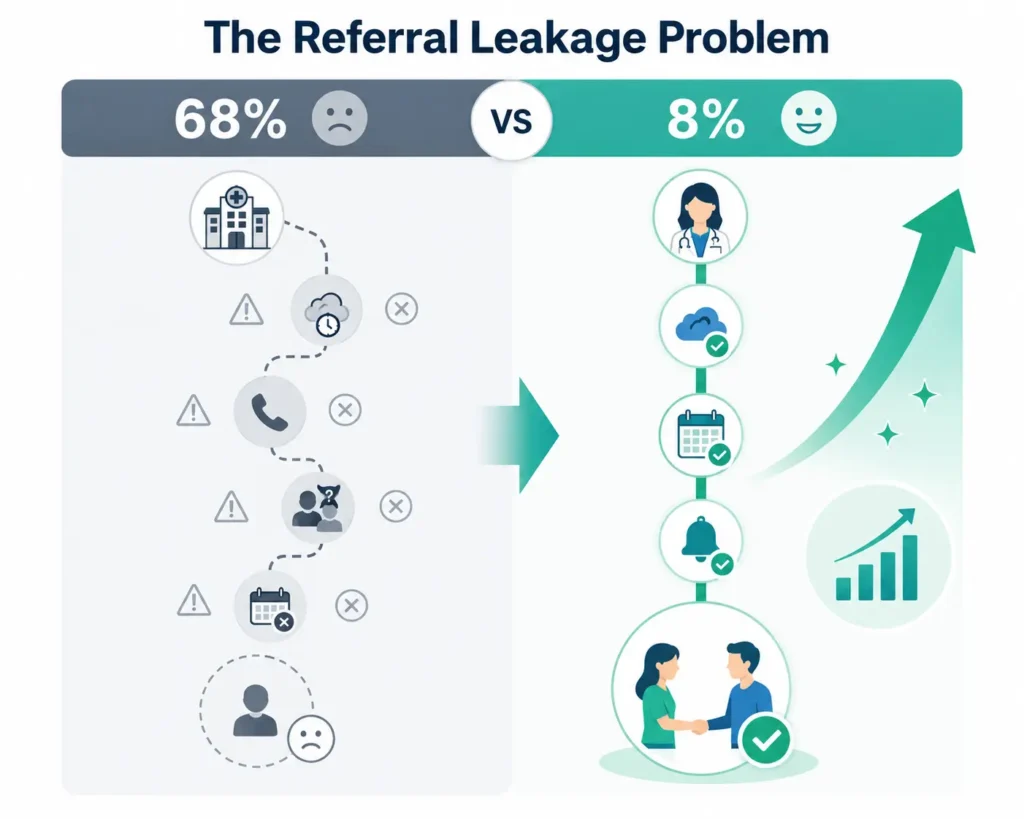
Sixty-eight percent of specialist referrals never get completed when clinics rely on traditional methods. For a mid-sized Texas clinic making 200 referrals per month, that means 136 patients a month are not getting the care they were sent to receive. The downstream revenue loss on that alone runs over $40,000 every single month.
The staff time is just as alarming. Each referral takes 15 to 20 minutes of phone calls, faxing, and follow-up. Thirty-five percent of those calls go to voicemail. Medical records arrive late or not at all. And because insurance eligibility verification did not happen upfront, a significant slice of the claims that do get submitted come back denied.
From the patient side, 54 percent say getting a specialist appointment is genuinely difficult, according to the American Medical Association. The average wait from referral to appointment stretches 24 to 28 days. Forty-one percent give up entirely before they ever see the specialist. That is not a patient problem. That is a system problem.
What Real-Time Online Booking Actually Means
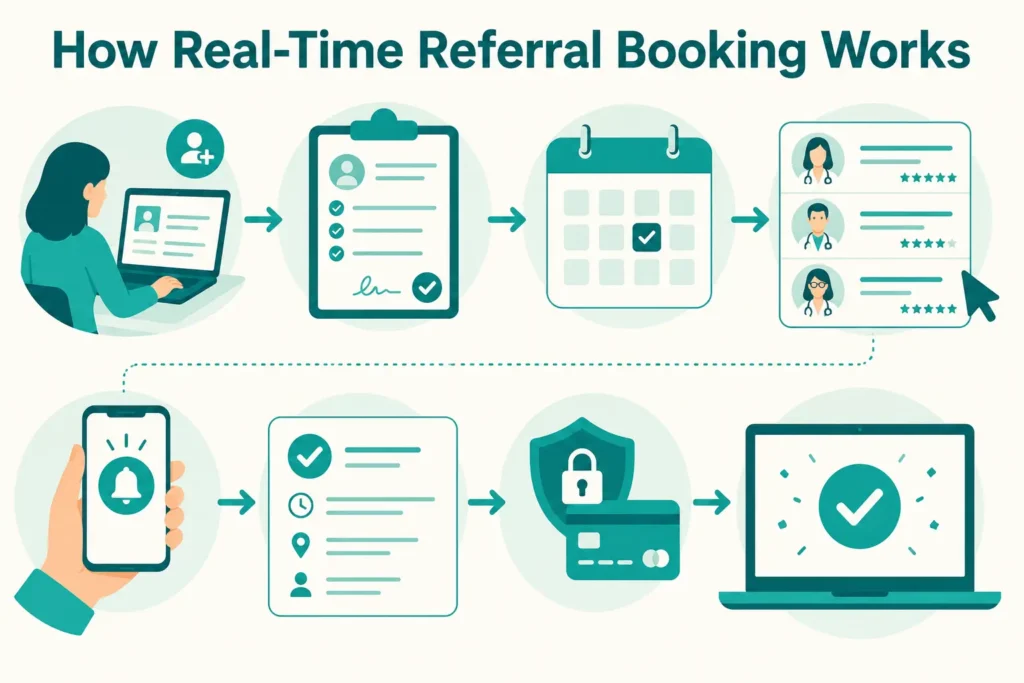
Real-time online booking for specialist referrals is not a scheduling app. It is a connected workflow that replaces the phone-and-fax process entirely. The physician identifies the need, enters it into the system, and the platform does the rest within about 90 seconds.
Insurance eligibility verification happens in five seconds. The system checks the patient’s coverage, confirms the specialist is in-network, and flags any authorization requirements before anyone picks up a phone. Then it pulls live calendar availability from the specialist’s office and lets the patient leave with a confirmed appointment already in hand.
The difference from traditional referral methods is not just speed. It is certainty. Instead of handing a patient a phone number and hoping they follow through, the appointment is secured before they walk out the door. Medical records transfer automatically. The patient gets a text confirmation with directions and pre-visit instructions. And the referring clinic gets notified when the patient shows up.
That closed loop is what turns a 32 percent referral completion rate into a 92 percent one.
What This Does to Your Revenue
The math on referral leakage is stark once you actually run it. Two hundred monthly referrals with 68 percent leakage means 136 patients not completing visits. At an average downstream value of $300 per referral, that is $40,800 walking out the door every month, or $489,600 a year.
Real-time online booking brings leakage down to around 8 percent. That recovers roughly $36,000 monthly. For a single clinic, the annual recovery is over $430,000. That figure does not include the reduction in claim denials, which drop from 18 percent to around 2 percent when authorization is verified upfront.
On the operational side, staff time per referral drops from 18 minutes to 5 minutes. For 200 monthly referrals, that is 43 hours of staff time freed up every month. That is more than a full-time position worth of capacity redirected to actual patient care rather than chasing callbacks and resending faxes.
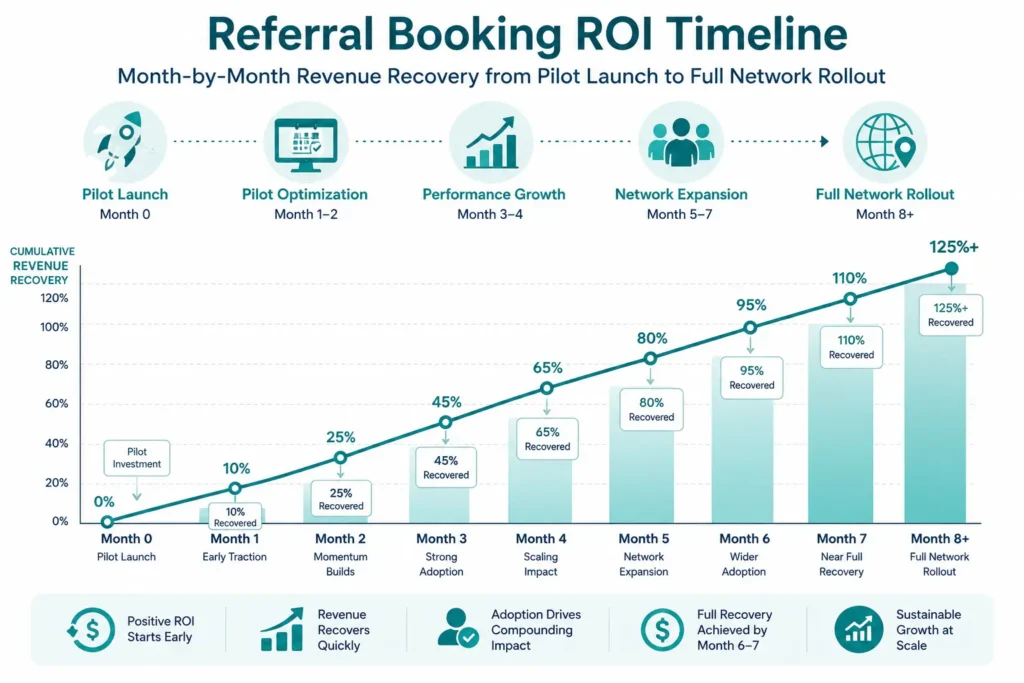
Healthcare revenue recovery at this scale typically takes six to nine months to hit break-even on implementation costs. The practices that move first capture both the financial recovery and the patient loyalty that comes with it.
The Telehealth Problem Makes This Even More Urgent
Thirty-eight percent of primary care visits now happen over telehealth, according to the American Telemedicine Association. Virtual visits have no physical handoff point. There is no front desk to hand the patient a referral slip. There is no staff member walking them to the scheduling counter.
Referral leakage rates for telehealth visits already sit at 76 percent, compared to 68 percent for in-person visits. Without real-time online booking, a telehealth-first practice is essentially handing patients a phone number at the end of a video call and expecting them to follow through.
Telehealth referrals need digital-first solutions. The same platform that books specialist referrals in-person can schedule appointments during a virtual visit, send digital confirmation to the patient portal, and route medical records automatically to the receiving provider. One telehealth-first practice in the US took referral completion from 24 percent to 89 percent using exactly this approach.
For practices in Texas managing a mix of in-person and virtual patients across a large geographic area, this kind of healthcare efficiency is no longer optional. It is competitive positioning.
Three Texas Clinics That Fixed Their Referral Problem
Three Texas clinics prove real-time referral booking works. Here are their transformation stories showing dramatic improvements in patient care and revenue.
A Multi-Specialty Group With 45 Providers
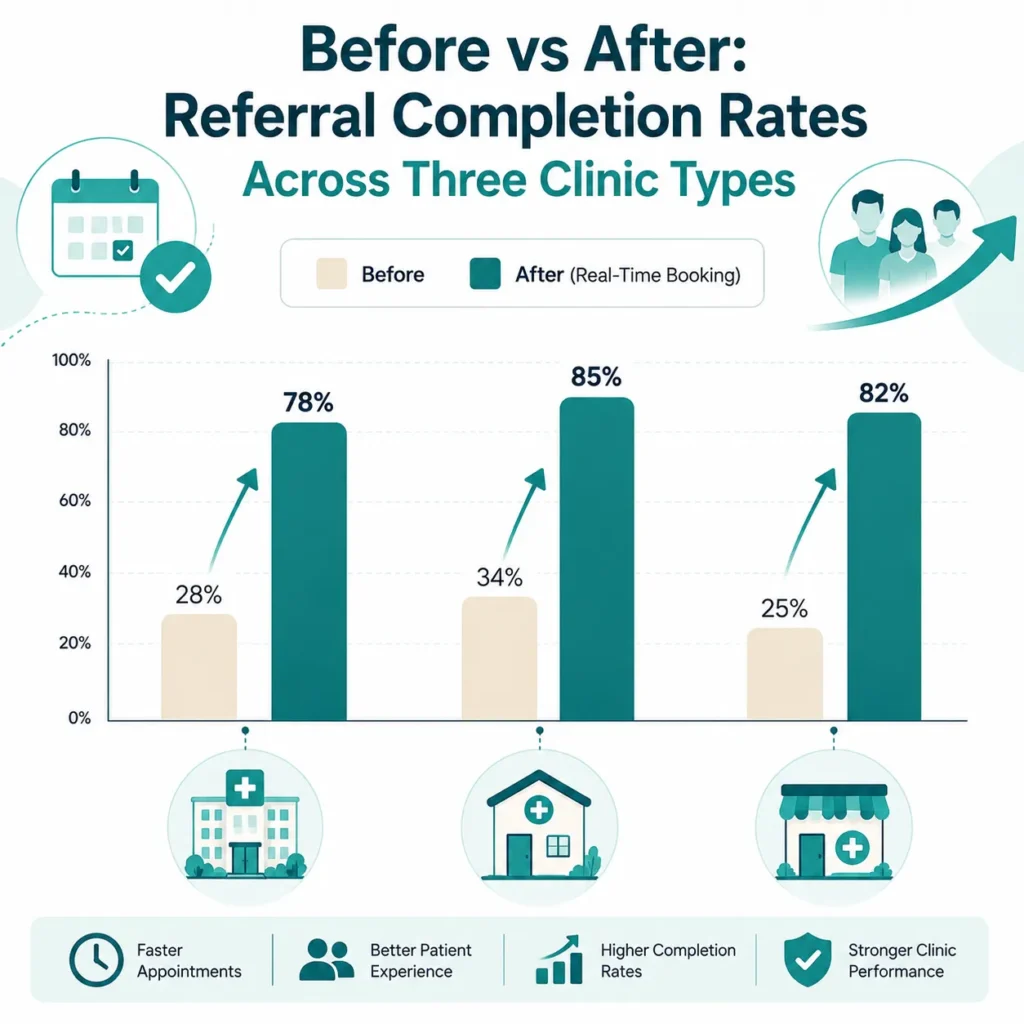
Before implementing real-time booking, this practice across 12 locations completed only 34 percent of referrals. Staff spent 95 hours a month on referral coordination. Patient complaints about scheduling came in at 23 per month.
Six months after implementation: referral completion hit 91 percent, staff time dropped to 22 hours per month, and patient complaints fell to 3. Monthly revenue increased $127,000. The reduction in staff hours alone freed up more than a full-time position for patient-facing work.
A Federally Qualified Health Center Serving an Underserved Population
This clinic faced 22 percent authorization denials and a 71 percent referral abandonment rate. Average time from referral to specialist visit was 34 days. After implementing real-time online booking with built-in referral authorization workflows, denials dropped to 4 percent, abandonment fell to 14 percent, and specialist access improved to an average of 9 days. Emergency visits for preventable conditions dropped 38 percent.
A 100 Percent Telehealth Primary Care Practice
With no physical location, traditional referral methods simply did not work. Referral completion sat at 24 percent. After moving to a digital-first real-time booking model, completion reached 89 percent, patient satisfaction climbed from 3.2 to 4.8 out of 5, and the practice expanded its doctor referral network to 350 specialists across 45 states. The improved referral completion rate was also what qualified them for value-based care contracts requiring 85 percent completion minimums.
What It Takes to Actually Implement This
The First Two Weeks: Understand What You Are Working With
Before choosing a platform, track your current referral completion rate for 30 days. Document how much staff time goes into each referral. Pull your denial rates for referral-related claims. This baseline is what makes the ROI case to leadership and what tells you where the biggest leaks are.
At the same time, audit your specialist network. Confirm current contact information for your top referral destinations. Identify which specialists have the highest referral volumes. Check whether their appointment availability is accessible through any digital directory. Many practices discover during this step that 20 to 30 percent of their specialist contacts are outdated.
For more on closing the revenue gaps that start before the referral even happens, our guide on
How incomplete referrals affect the revenue cycle covers the front-end process issues that compound into billing problems downstream.
Weeks Three and Four: Choose a Platform and Design Your Workflow
The platform needs to do four things well: check insurance eligibility in real time, access live specialist calendars, transfer medical records securely, and track appointment completion automatically. Pre-built integration with your EHR, whether Epic, Cerner, or Athenahealth, cuts implementation time from months to six to twelve weeks.
Map out who initiates referrals in your practice, how authorization approvals flow, and what patients need to know before their specialist visit. These decisions shape your workflow templates and your patient notification setup. Build this before you train anyone, because training without a clear workflow is what leads to adoption resistance.
The American Medical Association referral process guidance is a useful reference for defining who owns each step, especially for practices navigating the question of primary care referral responsibility versus specialist-side intake requirements.
Month Two: Pilot With One Department
Select one high-volume department and two or three specialists for the pilot. Run the new system in parallel with old methods for two to four weeks. Staff get comfortable with the workflow, problems surface while the stakes are still small, and you have real completion rate data to share with leadership before the full rollout.
Healthcare appointment scheduling software only delivers its value when staff actually use it. Assign a referral champion in the pilot department. Give them a point of contact for questions. Celebrate the first week where completion rates beat the baseline. Small wins build the momentum that carries the broader rollout.
For practices managing prior authorization alongside referral workflows, our overview of
prior authorization bottlenecks and how to reduce them covers the overlap between authorization requirements and referral denial rates.
The Real Impact: Why Referral Completion Matters Beyond Money
When a physician writes a referral, they’re making a clinical decision. They saw something that needed specialist attention. Every referral that falls through is a clinical decision that never got acted on. A patient with undiagnosed hypertension who never makes it to cardiology isn’t just a missed billing opportunity. They’re people whose condition continues without proper management. Patient experience matters too; practices that make specialist access easy earn the loyalty that fills schedules without marketing spend. The 38 percent drop in emergency visits at clinics that fixed their referral process wasn’t a billing metric. It was people staying healthy instead of ending up in the ER.
Referral leakage is when a patient gets referred but never actually shows up to the specialist. For a Texas clinic making 200 monthly referrals, that gap translates to $40,000 or more in lost revenue every single month.
It depends on your insurance. HMO plans require one. PPO plans usually do not but increasingly ask for one anyway. Checking eligibility upfront at the time of booking eliminates most of the confusion before it starts.
Real-time platforms verify insurance and flag authorization requirements now a referral is created, usually in under five seconds. That alone prevents the 18 percent denial rate that comes from submitting claims without proper authorization.
The same way, but leakage runs even higher at 76 percent because there is no physical handoff. Real-time booking fixes this by scheduling the specialist appointment during the virtual visit and sending confirmation directly to the patient.
Because they are clinical decisions. When a specialist visit does not happen, the condition goes unmanaged. Fixing referral leakage improves patient outcomes just as much as it improves revenue.
Take Control of Your Referral Process Today
A regional health system implemented real-time booking and watched referral completion jump from 38 to 94 percent in six months. That’s the competitive difference in today’s healthcare market.
Integrate Point helps practices like your build referral systems that work better patient outcomes, stronger provider relationships, and revenue recovery that pays for itself. Your community notices when you get referrals right. Your patients notice. Your reputation is growing. Stop losing referrals and start building the practice you deserve.