There is a moment most clinic managers know well. A patient was referred to a specialist three weeks ago. Nobody followed up. The appointment never got booked. The patient went somewhere outside the network. The revenue went with them. And nobody in the practice even noticed until the end of quarter numbers came in looking worse than expected.
That is not a staffing failure. That is a data failure. And data analytics in healthcare exists precisely to close that gap before it costs you another patient, another claim, or another quarter of avoidable losses.
This blog walks through how referral patterns affect your revenue and care quality, what the right data actually reveals, and how Texas, US clinics and health systems are using analytics to make smarter decisions every single day.
- The Real Cost of Managing Referrals Without Data
- What Referral Leakage Actually Looks Like in Practice
- How Referral Tracking Changes What You Can See
- Closing the Referral Loop: The Step Most Clinics Skip
- Provider Relationship Management: The Part Analytics Makes Smarter
- What the Metrics Actually Tell You
- How Clinical Workflow Optimization Connects to Referral Data
- How This Connects to Your Clinics Revenue Cycle
- FAQ
- How Integrate Point Helps Texas Practices Use Their Referral Data
The Real Cost of Managing Referrals Without Data
Most practices know referrals matter. Fewer know exactly what is happening to those referrals after they leave the building.
The referral goes out. The patient gets a name and a phone number. What happens next is largely invisible unless someone is actively tracking it. Did the patient call in and book a visit? Were they actually seen? Did they come to the appointment? After the visit, did a claim come back into your system?
Without referral tracking, none of those questions have reliable answers. And when you cannot answer those questions, you cannot fix the problems hiding inside them.
According to CMS, care coordination gaps including incomplete referral follow through are among the leading drivers of preventable hospital readmissions and avoidable costs across US healthcare systems. That means the referral you sent and forgot about is not just a revenue problem. It is a patient safety problem, too.
What Referral Leakage Actually Looks Like in Practice
Referral leakage is the term for what happens when patients leave your network to see specialists elsewhere. It sounds like a billing term. It feels like a much bigger problem when you see numbers.
Studies shared by the Advisory Board show that referral leakage can cost health systems millions of dollars annually. For smaller Texas clinics, even a modest leakage rate translates into tens of thousands of dollars in lost revenue every year, revenue that was generated by your providers and your relationships but captured by someone else.
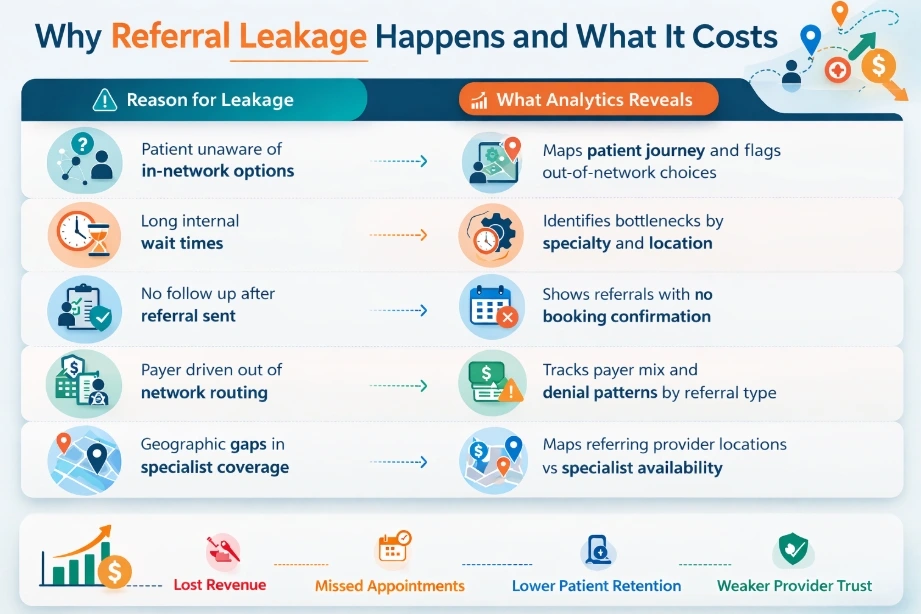
The reasons patients leak out of network are usually straightforward. They did not know an in-network option existed. The wait time for an internal specialist was too long. Nobody followed up to help them book. These are fixable problems. But only if you can see them.
That is exactly what data analytics in healthcare makes possible.
How Referral Tracking Changes What You Can See
Good referral tracking does not just count how many referrals went out. It follows each one through the entire journey. From the moment the referral is placed to the moment the specialist visit is completed, and the information comes back to the referring provider.
When that full picture is visible, patterns emerge that are impossible to spot otherwise. Certain specialists have consistently longer wait times. Some referring providers send a high percentage of patients out of network without realizing it. Certain insurance plans are associated with higher rates of referral denial or non-completion.
According to AHRQ, practices that implement structured referral tracking report measurable improvements in care continuity and patient satisfaction within the first year. Patients feel the difference when their care is coordinated. They come back. They refer to others.
Closing the Referral Loop: The Step Most Clinics Skip
Nearly half of all referrals in the US never convert into a completed specialist appointment. That number is staggering when you think about what it means for patients and for revenue.
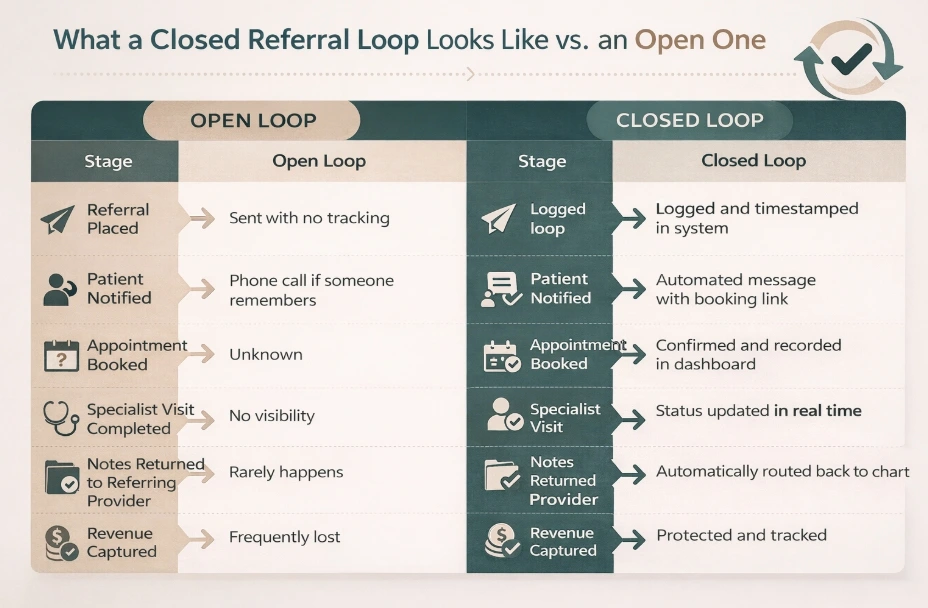
The referral loop is the full cycle from referral placement to completed visit to information returned to the referring provider. Closing that loop requires more than sending a fax and hoping for the best. It requires a system that tracks where each referral is at every stage and alerts the right person when something stalls.
Healthcare dashboards built around referral data make this visible in real time. Your team can see at a glance which referrals are pending, which appointments were booked, which patients did not show up, and which specialist relationships have the highest completion rates.
According to HealthIT.gov, practices using real-time clinical dashboards report faster identification of care gaps and significantly lower rates of lost to follow up patients compared to those relying on manual tracking systems.
Provider Relationship Management: The Part Analytics Makes Smarter
Referrals are also relationship currency. The specialists you refer to most often become your clinical partners. The ones who deliver good outcomes, communicate well, and see your patients promptly strengthen your practice’s reputation. The ones who do not quietly erode it.
Provider relationship management used to rely entirely on gut feel and personal history. Analytics changes that. Your data can show you which specialist relationships are performing well by measuring completion rates, return communication rates, patient satisfaction outcomes, and payer reimbursement patterns tied to specific providers.
This is not about judging colleagues. It is about making informed decisions that protect your patients and your revenue. When a specialist consistently has long wait times or low completion rates, that is information your outreach team needs before the next referral goes out.
What the Metrics Actually Tell You
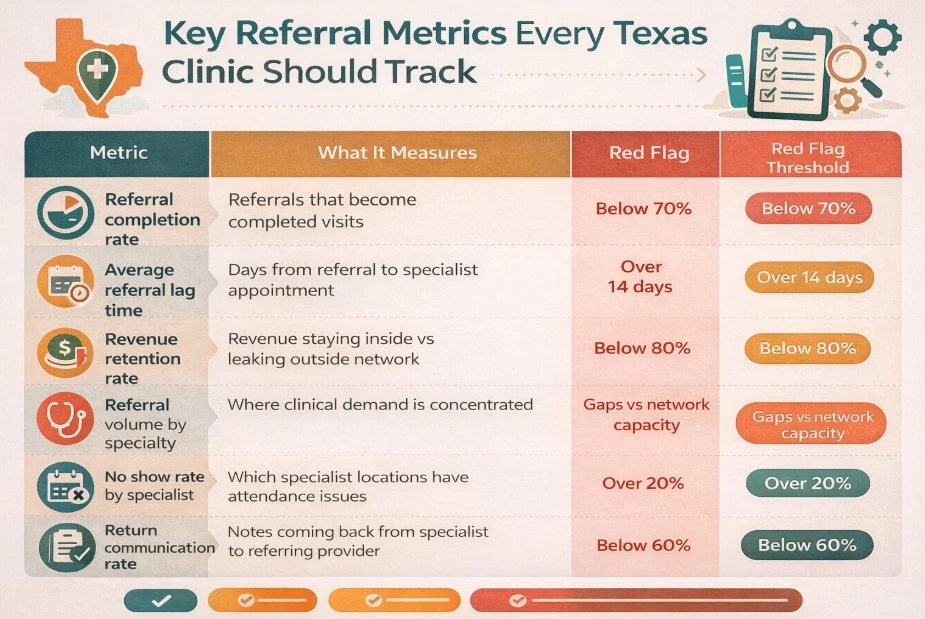
The value of data analytics in healthcare is only as strong as the metrics you choose to track. For referral management specifically, here are the numbers that matter most and what each one is telling you.
Referral Volume by Specialty
Shows you where your clinical needs are concentrated and where your network may have gaps. If cardiology referrals make up 40% of your outbound volume, but you only have two in network cardiologists, that is a capacity problem waiting to become a patient’s access problem.
The Referral Completion Rate
Tells you how many of your referrals actually result in a completed specialist visit. Anything below 70% is worth investigating. Below 50% is a system problem that needs immediate attention.
Average Referral Lag Time
Measures the gap between when a referral is placed and when the patient is seen. Long lag times hurt specialist access, frustrate patients, and in some cases delay critical diagnoses.
Revenue Retention Rate
Shows how much of the revenue generated by your referrals stays inside your network versus leaking out. This is the number that gets the attention of administrators and finance teams fastest.
According to HHS.gov, healthcare organizations that actively monitor referral performance metrics consistently outperform peers on both patient experience scores and financial sustainability indicators.
How Clinical Workflow Optimization Connects to Referral Data
Referral problems rarely exist in isolation. They are usually symptoms of deeper workflow issues. A high no show rate might mean patients are not being reminded. A low completion rate might mean the booking process is too complicated. A long, lag time might mean the scheduler is overwhelmed, or the specialist’s availability is not being checked in real time.
Clinical workflow optimization using referral data means tracing each problem back to its root cause inside the workflow and fixing it there. Not just at the surface level.
This is where technology earns its place. EMR referral modules inside systems like AthenaHealth, Epic, and Cerner give clinics the raw data. Business intelligence platforms like Power BI and Tableau turn that data into healthcare dashboards that make patterns visible. And referral management systems with built in analytics close the loop automatically, so staff are not chasing confirmations manually.
According to the American Medical Association, practices that invest in workflow optimization tools tied to referral data report measurable reductions in administrative time and improvements in healthcare operational efficiency within six to twelve months of implementation.
How This Connects to Your Clinics Revenue Cycle
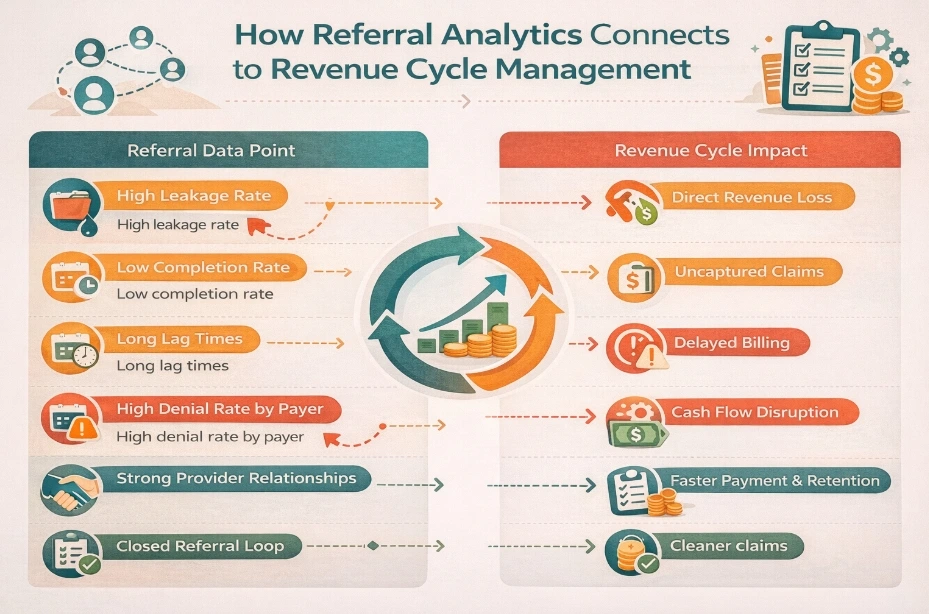
Referral management and healthcare revenue cycle management are more connected than most practices realize. When a referral goes outside your network, that’s money you didn’t get back. If a referral never turns into a finished visit, no claim ever gets sent in. When a specialist you work with falls short, your patients end up with a break in their care.
When referral data is integrated into your revenue cycle reporting, the full picture becomes clear. You can see not just how many referrals went out, but how much revenue each referral relationship is generating, which payers are associated with higher denial rates, and where your network needs to grow to capture more of the value your providers are creating.
This level of visibility changes how administrators make decisions. Network expansion plans become data driven. Contract negotiations with specialists becomes informed by actual performance. Capacity forecasting becomes possible instead of guesswork.
FAQ
Data analytics in healthcare referral management means using real data from your EMR and referral systems to track where patients go after a referral, whether they complete their appointments, and how much revenue stays inside your network. It provides clear, actionable insight that improves both patient care and financial performance.
Referral leakage happens when patients see specialists outside your network after a referral is made. It matters because the revenue from those visits does not return to your system. For clinics, even a modest leakage rate can mean significant annual losses that referral tracking, and analytics can help identify and recover.
Referral tracking follows each patient from the moment a referral is placed through to the completed specialist visit and the return of clinical notes. When that full loop is visible, care gaps close faster. Patients receive more coordinated care, and referring providers stay informed about what is happening with their patients.
The most important metrics are referral completion rate, average referral lag time, revenue retention rate, and return communication rate from specialists. These four numbers together give you a clear picture of whether your referral process is working, or if it is losing both patients and revenue.
Every incomplete referral is a claim that never gets submitted, and every patient who leaks out of network is revenue that does not return. Referral analytics connected to healthcare revenue cycle shows the full financial impact of your referral patterns and helps administrators make network and contracting decisions based on real performance data.
How Integrate Point Helps Texas Practices Use Their Referral Data
At Integrate Point, we work with clinics, multi provider practices, and hospital departments across Texas, US to build referral analytics systems that turn raw data into decisions.
We help you identify your top leakage points, build healthcare dashboards that your team will actually use, and implement referral tracking workflows that close the loop without adding work to your staff’s day.
Whether you are starting from spreadsheets or looking to get more out of an existing EMR, our team brings the operational knowledge and the technical capability to make your referral data work for you.
Book a consultation with our team today and we will show you the top three referral metrics to track first.